





The proof: Every 10 minutes pays a jackpot. Try now! Spin to Win Here -> psee.io/8qtsv7
Vietnam may look relatively narrow on a map, but travelling from one end of the country to the other takes time. For travellers hoping to experience Hanoi, Central Vietnam and Ho Chi Minh City in one trip, domestic flights in Vietnam are often the most practical way to cover long distances without losing entire days on the road.
Vietnam has a well-developed domestic air network connecting its major cities and many popular holiday destinations. This guide covers the most useful routes, Vietnam's main domestic airlines and airports, approximate flight times, baggage considerations, and practical tips to help you plan your journey.
Vietnam stretches for more than 1,600 kilometres from north to south. Its long, narrow geography means that destinations that appear relatively close on a map can require many hours of overland travel.
The classic example is Hanoi to Ho Chi Minh City. A direct flight takes just over two hours, making flying particularly useful if you have two or three weeks and want to experience several regions of Vietnam. Current published schedules show this as one of the country's major domestic air corridors.
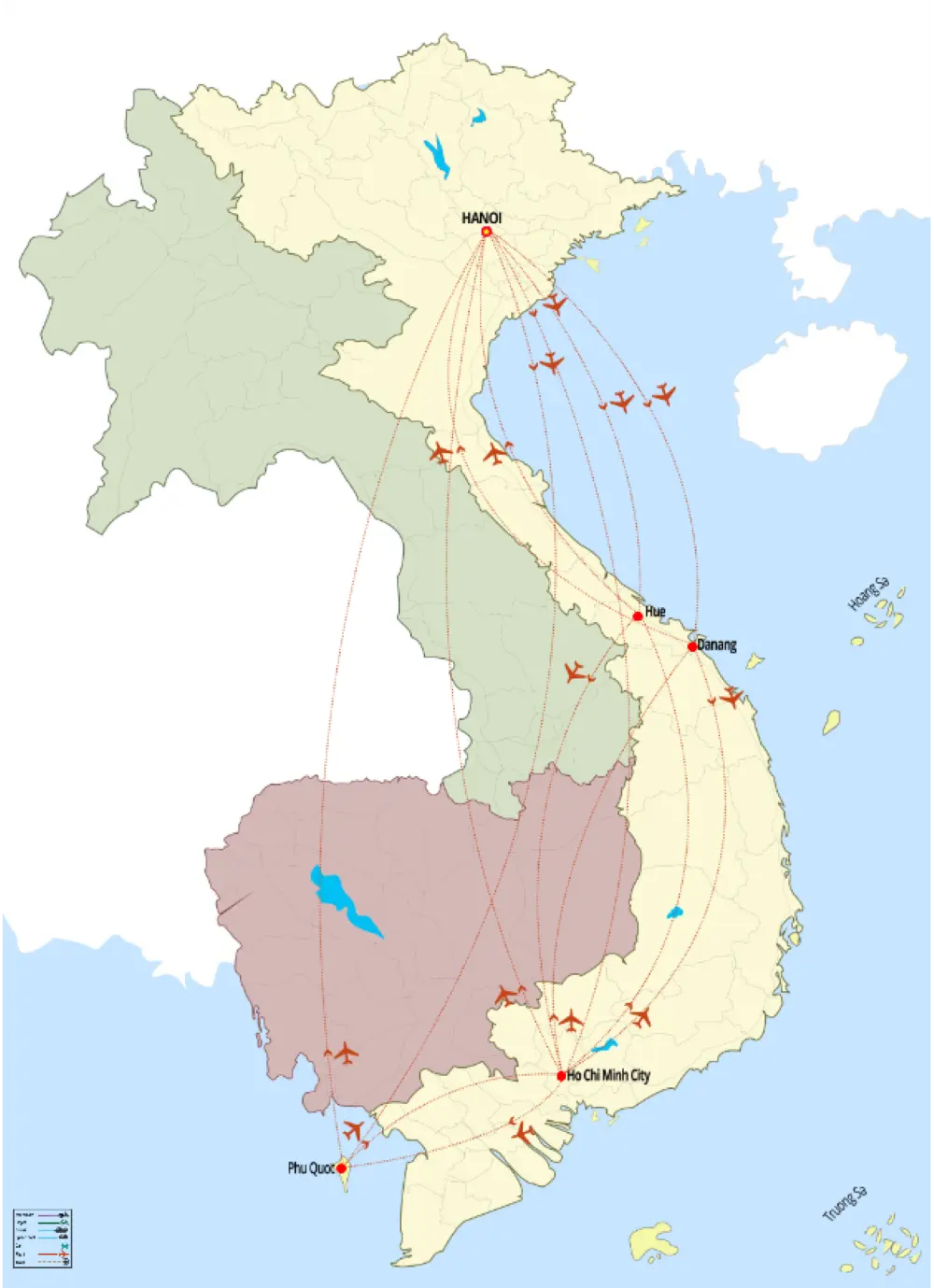
Domestic flights are especially useful when moving between distant regions - for example, Hanoi to Hue or Da Nang, Central Vietnam to Ho Chi Minh City, or Ho Chi Minh City to Phu Quoc. They allow you to spend more of your holiday exploring rather than simply getting from one place to another.
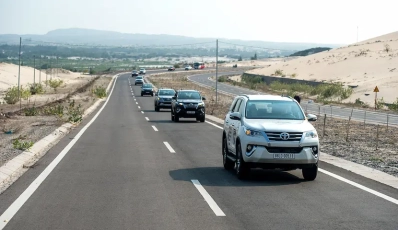
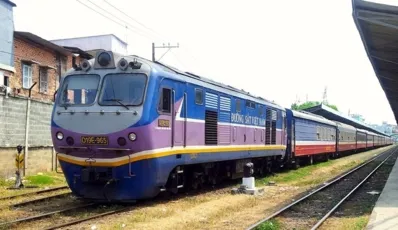
That doesn't mean you should fly everywhere. Trains, private cars and road transfers are often better for shorter journeys where the scenery and stops along the way are part of the experience. Hanoi to Ninh Binh, Hue to Hoi An and Ho Chi Minh City to the Mekong Delta, for example, make more sense overland.
A good Vietnam itinerary usually combines both: flights for the long north - central - south distances and road or rail travel for shorter regional journeys.
Vietnam's major tourist destinations are connected by direct flights, although schedules and frequencies vary by airline, season and travel date.
Hanoi to Ho Chi Minh City
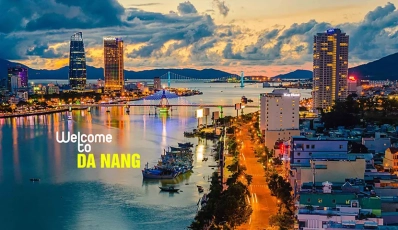
Hanoi to Da Nang
Hanoi to Hue
Hanoi to Phu Quoc
Ho Chi Minh City to Da Nang
Ho Chi Minh City to Phu Quoc
Da Nang to Phu Quoc
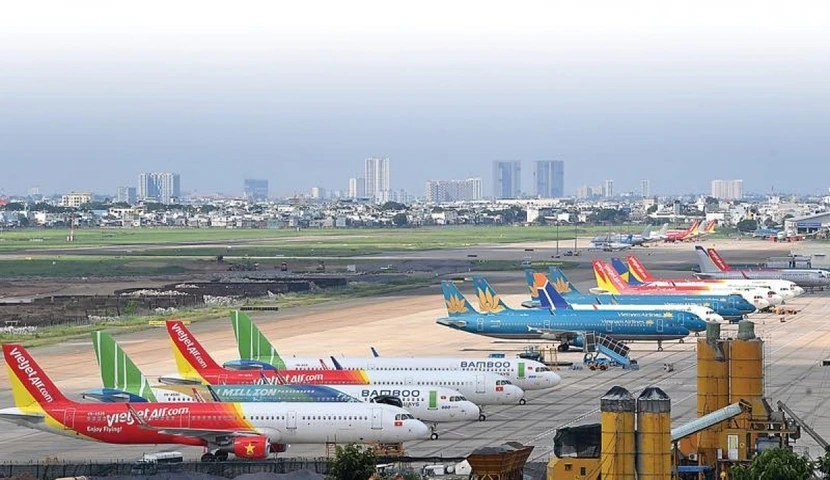
Vietnam's domestic aviation market includes Vietnam Airlines, VietJet Air, Bamboo Airways, Vietravel Airlines and Sun Phu Quoc Airways. Their route networks, frequencies and fare conditions are not identical, so comparing only the headline ticket price can be misleading.
Travellers currently have several airlines to choose from for domestic journeys. The most useful option depends on your route, schedule, baggage needs and fare conditions rather than simply which airline advertises the lowest base price.
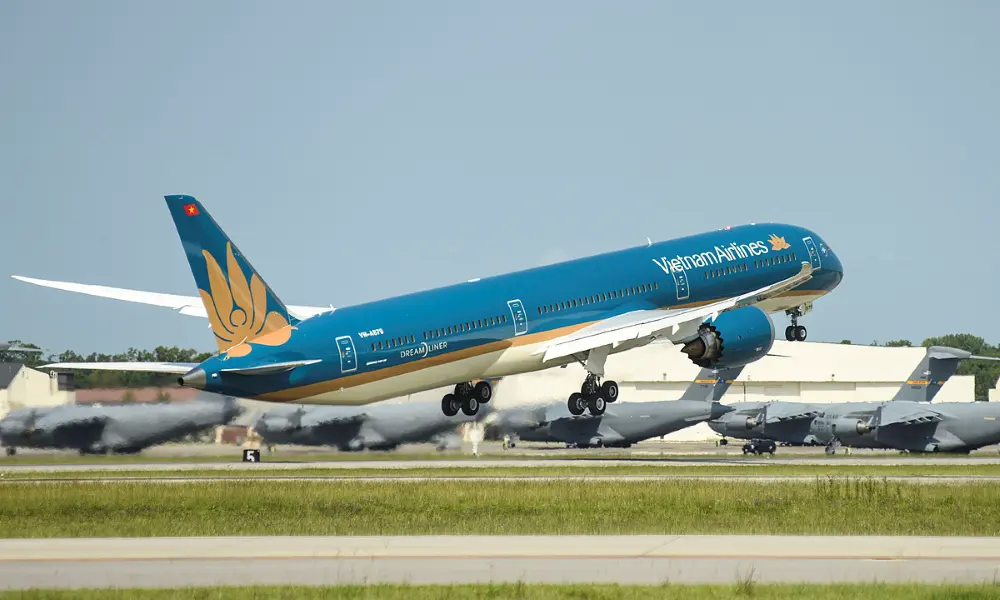
Vietnam Airlines is Vietnam's national carrier and operates one of the country's most extensive domestic networks. It can be particularly convenient for travellers who value included baggage and full-service fares.

VietJet Air is a major low-cost carrier with an extensive domestic network and frequent departures on popular routes.

Bamboo Airways operates a smaller domestic network than it did previously, so its current routes should be checked before planning an itinerary around the airline.
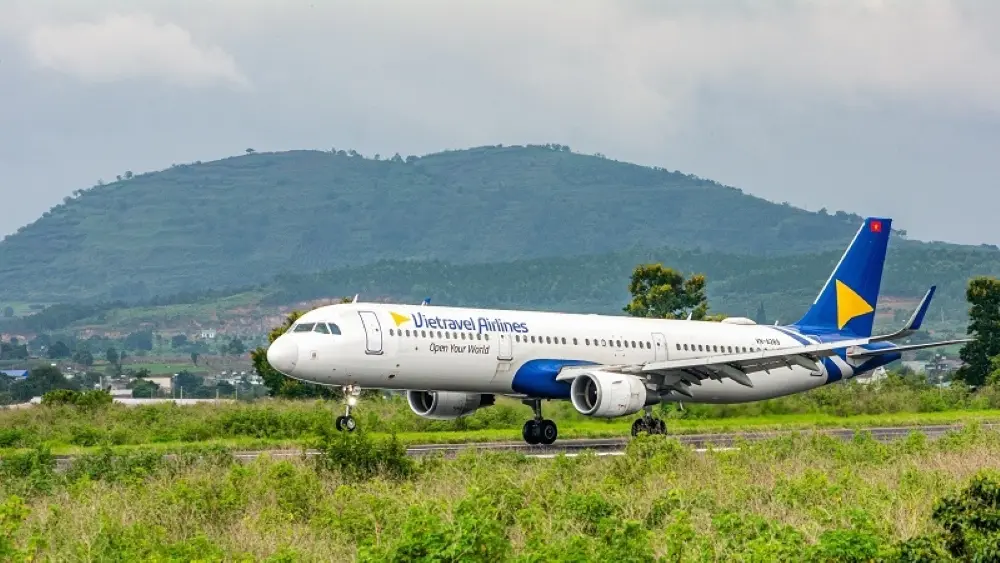
Vietravel Airlines serves selected domestic routes connecting major cities and tourism destinations.
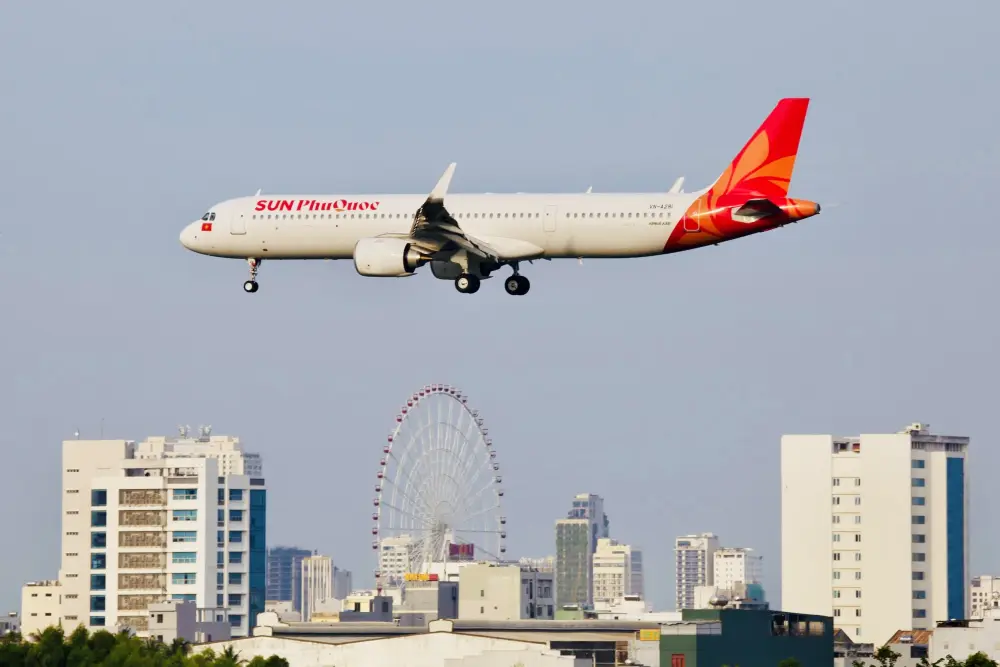
Sun Phu Quoc Airways is a newer Vietnamese airline built around Phu Quoc as its strategic hub. Its domestic network currently connects Phu Quoc with destinations including Hanoi, Ho Chi Minh City, Da Nang, Nha Trang, Hai Phong and Van Don, while further expansion is planned.
This makes it particularly relevant for travellers building an itinerary that includes Phu Quoc alongside other major destinations.
For most international travellers, there is no single best domestic airline in Vietnam. Compare the final fare after baggage, departure time, route convenience and ticket conditions rather than choosing solely by the advertised price.
Tips: Don’t compare domestic airlines by ticket price alone. Always check the final fare after adding baggage, seat selection, and any change fees you may need.
There is no fixed price for domestic flights in Vietnam. Fares change according to the route, airline, departure time, how early you book and travel season.
As a broad planning reference, ordinary one-way fares on major routes can often fall somewhere between VND 700,000 and VND 2,800,000, depending heavily on the route and booking conditions. Short routes such as Ho Chi Minh City to Phu Quoc can be cheaper, while longer routes such as Hanoi to Phu Quoc tend to cost more. These figures should be treated only as planning estimates rather than guaranteed fares.
Domestic airlines commonly sell each flight sector separately, so a round trip is not necessarily cheaper than purchasing two one-way flights. This gives travellers more flexibility to arrive in one city and continue their journey from another.
For a multi-destination Vietnam itinerary, this is particularly useful because you rarely need to return to your starting city simply to catch another flight.
A cheap fare displayed in a search result may not represent what you eventually pay. Depending on the airline and fare class, you may need to add checked baggage, seat selection or other optional services.
Always compare the final price with the baggage you actually need, especially when comparing a low-cost carrier with a full-service airline.
Domestic fares can rise significantly around Tet, national holidays and popular summer travel periods, particularly on routes connecting Hanoi and Ho Chi Minh City with major leisure destinations.
For example, Vietnam's Civil Aviation Authority reported substantially higher fares on routes such as Hanoi - Da Nang, Hanoi - Phu Quoc and Ho Chi Minh City - Phu Quoc around the April - May 2026 holiday period, with some popular Economy departures also selling out.
If your dates coincide with a major Vietnamese holiday, booking early gives you a better choice of both fares and convenient flight times.
Rather than memorising every airport in Vietnam, it is more useful to understand the country's main aviation gateways and the travel regions they connect.
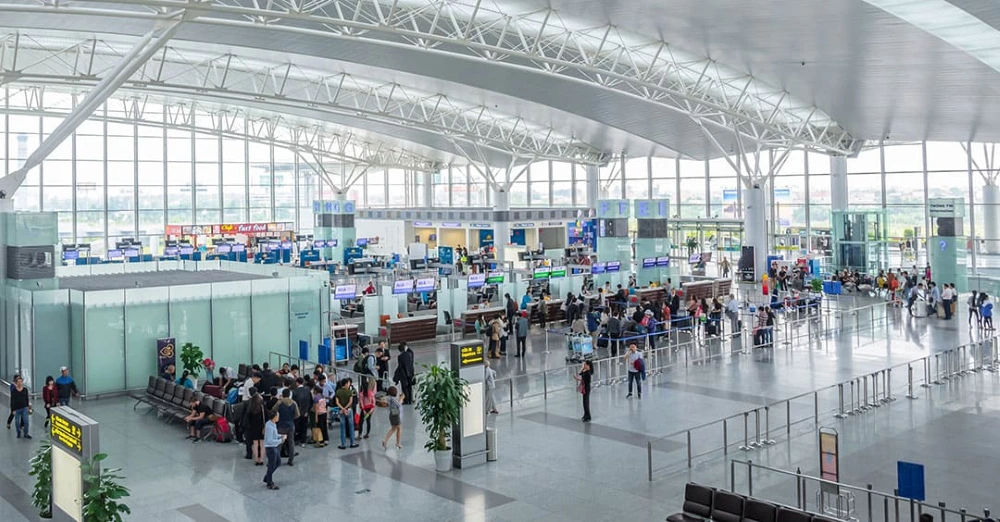
Noi Bai International Airport (HAN)
Noi Bai International Airport (HAN) in Hanoi is the main gateway to Northern Vietnam. It is the natural starting point for journeys to Hanoi, Ninh Binh, Ha Long Bay, Mai Chau, Pu Luong, Sapa and Ha Giang, with onward travel by road or rail depending on the destination.
For travellers exploring the north, flying into Hanoi and continuing overland is usually more practical than trying to fly between individual northern destinations.
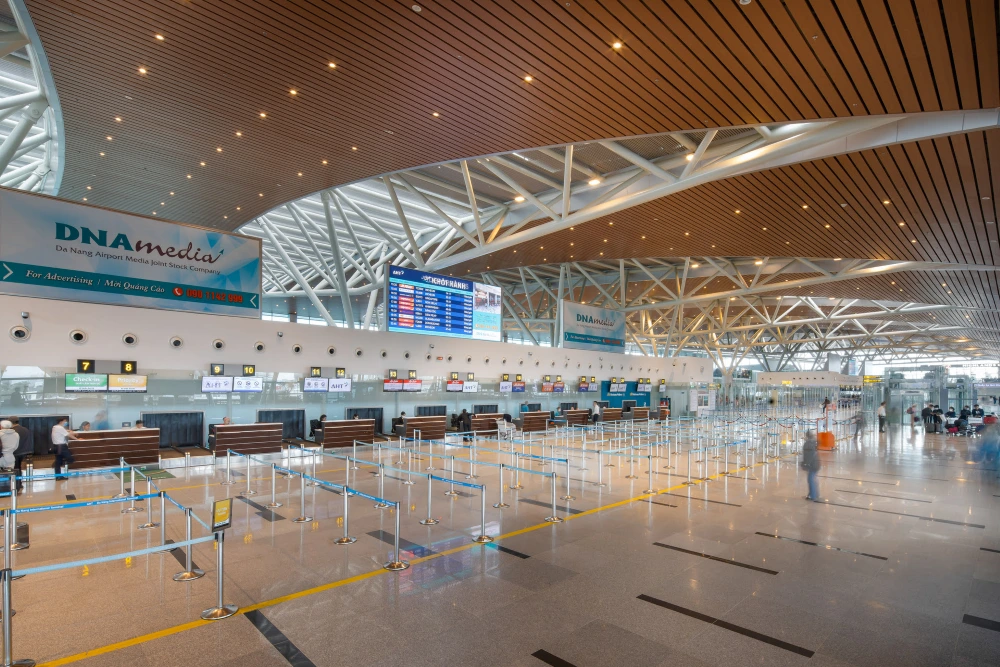
Da Nang International Airport (DAD)
Da Nang International Airport (DAD) is the most convenient major gateway for Da Nang and Hoi An, while its location also makes it useful for itineraries extending north toward Hue.
Phu Bai International Airport (HUI) serves Hue and is convenient when you want to begin your Central Vietnam journey directly in the former imperial capital.
Cam Ranh International Airport (CXR) is the main airport for Nha Trang. Remember that CXR is located outside central Nha Trang, so airport transfer time needs to be included in your plans.
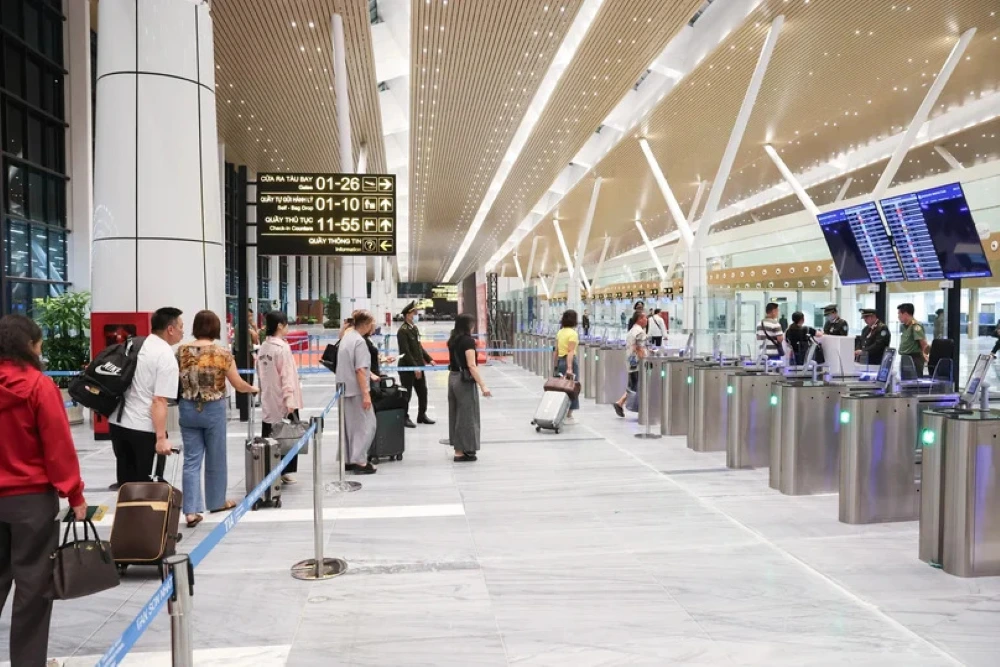
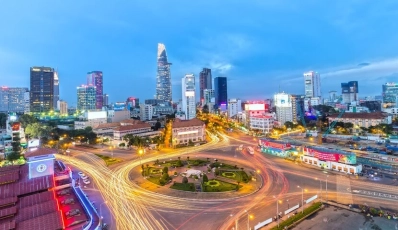
Tan Son Nhat International Airport (SGN)
Tan Son Nhat International Airport (SGN) in Ho Chi Minh City is Southern Vietnam's principal aviation hub and an important starting point for journeys into the Mekong Delta as well as connections elsewhere in the country.
Phu Quoc International Airport (PQC) provides direct access to Phu Quoc Island and is increasingly well connected with other Vietnamese tourism centres.
Together, these gateways make it relatively easy to combine Northern, Central and Southern Vietnam without flying between every individual destination.
Domestic flying in Vietnam is generally straightforward. These practical points will make the airport experience easier.
Arrive Early
For most domestic flights, plan to arrive 1.5 - 2 hours before departure. Domestic check-in counters commonly open around two hours before departure and may close around 40 minutes before the scheduled flight.
If you've already checked in online and only have cabin baggage, arriving around 60 minutes before departure may be sufficient at some airports, but always check your airline's current requirements.
During Tet, major national holidays and busy travel periods, allow approximately 2 - 2.5 hours, as check-in and security queues can be considerably longer.
Bring Your Passport
International travellers should carry their original passport, and the name on the booking should match the travel document. Online check-in is available for many domestic flights, although conditions vary by airline and airport.
Check Your Baggage Allowance
Baggage rules differ between airlines and fare classes. Some tickets include checked baggage while others only include cabin baggage, so check your allowance before confirming the ticket and add extra baggage in advance when necessary.
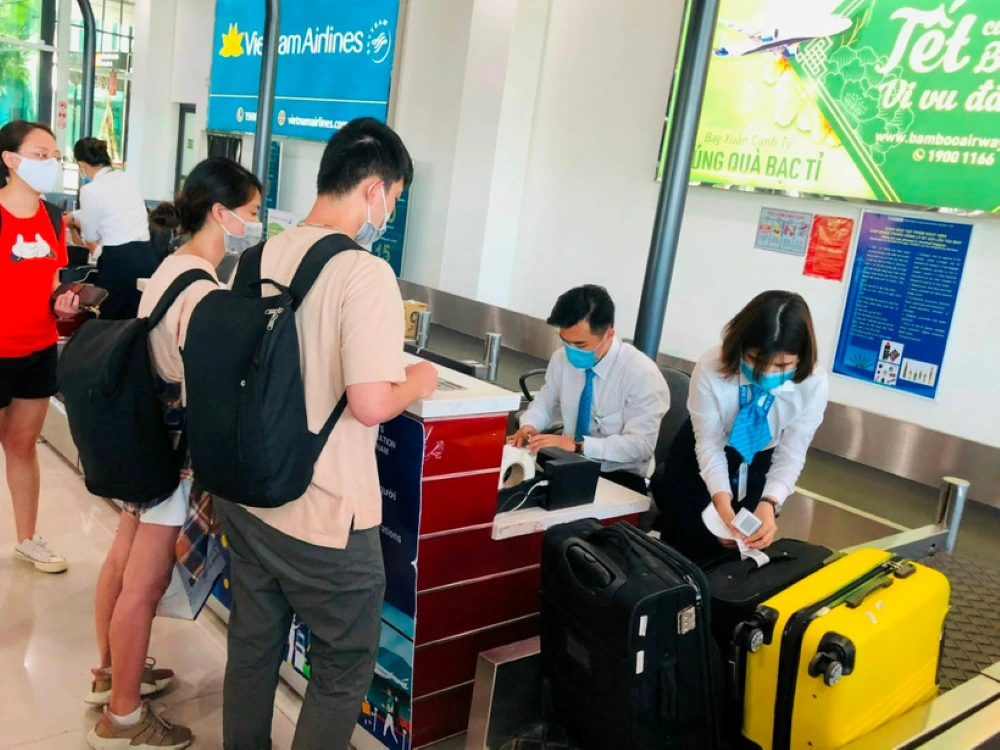
Check Your Airport and Terminal
Pay attention to airport codes such as HAN, SGN, DAD, CXR, PQC and HUI, as well as the terminal shown on your ticket.
At Noi Bai Airport in Hanoi, the international and domestic terminals are approximately one kilometre apart. Passengers changing terminals normally need to use the airport shuttle or another transfer option, so allow additional time.
At several smaller Vietnamese airports, domestic and international areas are located within the same terminal building or terminal complex, making transfers more straightforward.
Allow Time for Transfers and Connections
Flight time is only one part of the journey. Allow enough time to travel between your hotel and the airport, particularly in Hanoi and Ho Chi Minh City where traffic can add considerable transfer time.
If you're connecting from an international flight to a separately booked domestic flight, leave a generous buffer for immigration, baggage collection, customs and any terminal transfer.
Book Early During Peak Periods
Flights can fill quickly - and fares can rise sharply - around Tet, national holidays and peak summer travel periods. Depending on the route, travel date and demand, fares during these periods may be around 10-50% higher than on regular travel days, with the biggest increases often seen on popular routes and convenient departure times. If you're travelling during a peak period, book early rather than waiting for a last-minute fare.
Domestic flights work best when they save time between distant regions, not when they replace every journey on the ground.
Here are two examples of how IZITOUR combines flights with road transfers, cruises and local experiences in real multi-destination itineraries.
Hanoi – Ninh Binh – Ha Long Bay – (fly to) Hue – Hoi An & Da Nang – (fly to) Ho Chi Minh City – Cai Be
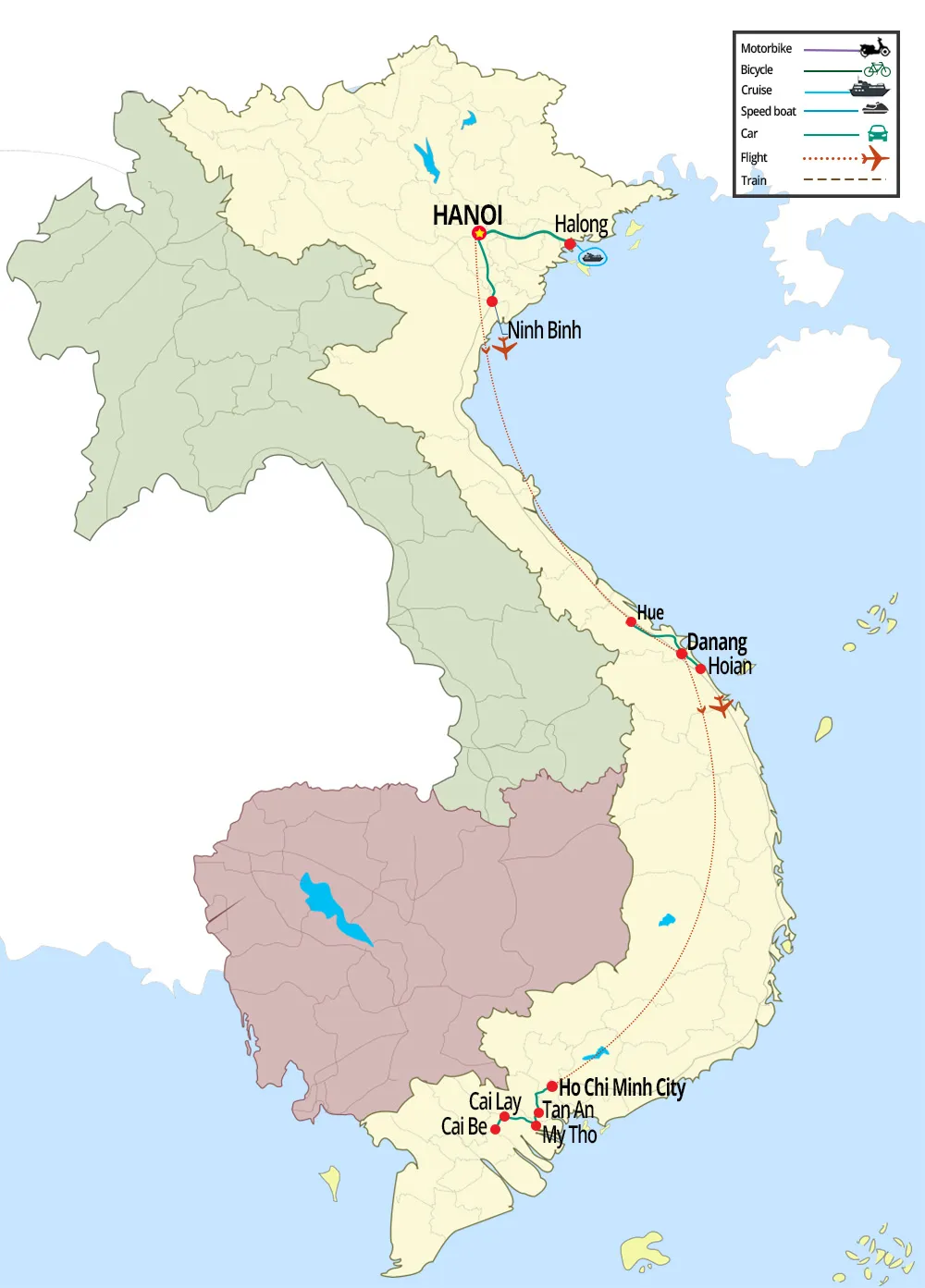
This itinerary combines overland travel through Northern Vietnam with domestic flights for the much longer transitions between regions.
Rather than flying between nearby destinations, travellers explore Hanoi, Ninh Binh and Ha Long Bay by road, then use air connections to reach Central and Southern Vietnam efficiently. This keeps travel time manageable while still allowing the countryside and local landscapes to remain part of the journey.
Hanoi – Ninh Binh – Ha Long Bay – (fly to) Hoi An – My Son – Hue – (fly to) Ho Chi Minh City – Cai Be – Cu Chi – (fly to) Phu Quoc
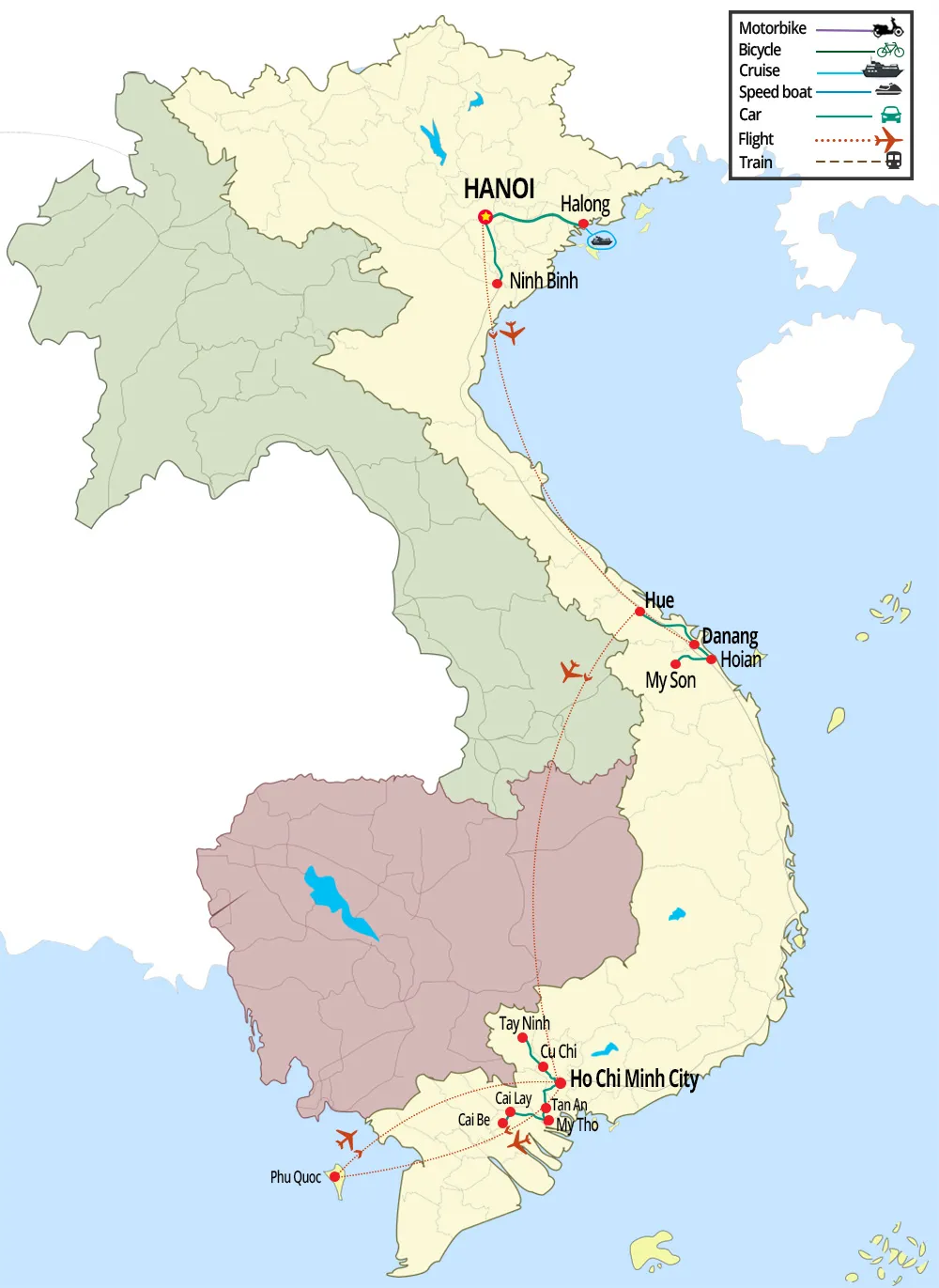
With 15 days, there is enough time to experience all three major regions of Vietnam and finish with a few days on Phu Quoc.
Flights are most valuable for the long regional transitions, while private transfers are better suited to journeys such as Hoi An - My Son - Hue and excursions around the Mekong Delta. A domestic flight to Phu Quoc then avoids a lengthy overland-and-ferry journey at the end of the trip.
The best Vietnam itinerary doesn't mean flying everywhere. Some journeys are simply more rewarding on the ground. A private transfer lets you stop along the way, a train can turn the journey into part of the experience, and travelling by road often brings you closer to landscapes and local life that you would otherwise fly over.
The key is to use domestic flights for long distances while choosing trains, private transfers and other forms of transport where they add something meaningful to the journey.
Planning a multi-destination trip to Vietnam? If you'd like help finding the right balance between domestic flights, private transfers, trains and local experiences, feel free to contact us on +84 382 536 266 or by email at [email protected]. Our IZITOUR team is on hand to create a tailor-made itinerary with the most convenient transportation for each part of your journey.
Read more:





 TRAVELERS' CHOICE 2026