
Earlier I thought differently, many thanks for the information.
__________
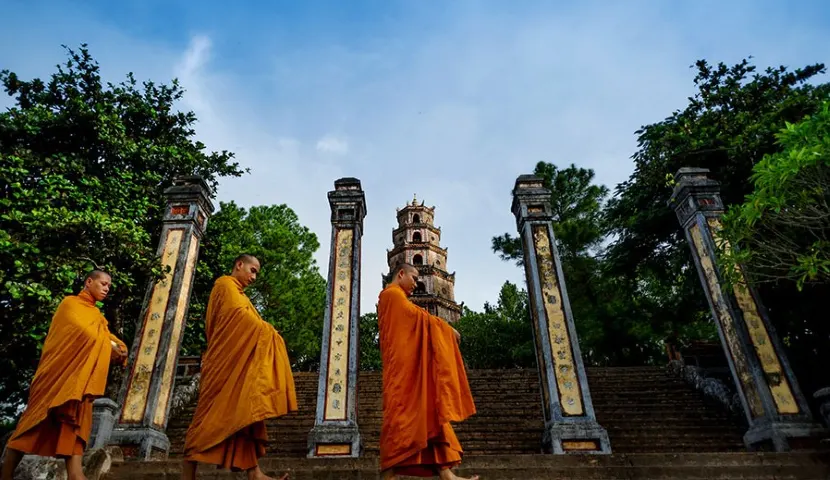
Hue is best known as the former imperial capital of Vietnam, but beyond its citadel, royal tombs and elegant garden houses lies another side of the city: a deeply spiritual landscape shaped by Buddhism, royal rituals and local beliefs. Ancient pagodas rise above the Perfume River, temple gates appear among pine-covered hills, and the sound of bells still marks the rhythm of monastic life. For travellers, exploring the temples and pagodas of Hue is not simply a sightseeing experience. It is an opportunity to understand how religion, architecture, history and everyday life have influenced the cultural identity of Central Vietnam.
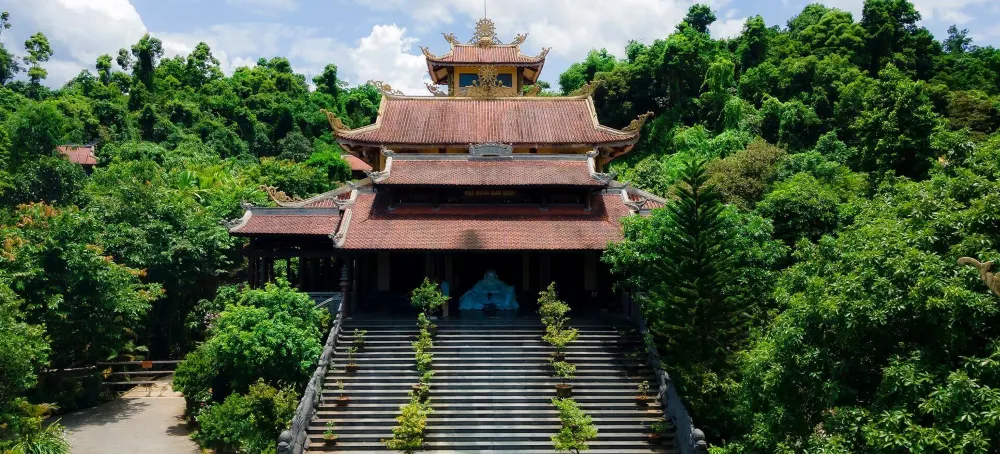
The architecture encountered along a journey through the temples and pagodas of Hue is generally more restrained than the richly decorated religious buildings found in other parts of Asia. Its beauty lies in its proportions, atmosphere and the relationship between the built and natural environments.
Some of Hue’s religious sites are closely connected to the Nguyen Dynasty, which ruled Vietnam from 1802 to 1945. Others began as modest hermitages or village places of worship before becoming important centres for Buddhist teaching. Together, they reveal a city where the sacred and the historical are rarely separate.
Among the most common features are:
Hue’s frequent rainfall and humid climate also influence the appearance of these places. Moss grows across walls, roof tiles darken, and garden paths become reflective after a downpour. Far from diminishing their beauty, these atmospheric conditions help accentuate their sense of age and tranquillity.
Another distinctive characteristic is the relationship between architecture and landscape. Many pagodas were built beside rivers, on hills or within wooded areas. Their locations were carefully selected to create harmony between the spiritual environment and the natural world.
It is also worth highlighting the distinction between temples and pagodas. A pagoda, or chùa in Vietnamese, is generally associated with Buddhism and may include halls dedicated to the Buddha, meditation spaces, monastic residences and ancestral altars. A temple, often called đền or miếu, may instead be dedicated to historical figures, national heroes, deities or local protective spirits.
In Hue, these traditions sometimes overlap. A single religious complex may combine Buddhist elements, ancestor worship, folk beliefs and architectural influences from the Nguyen royal court. This layered character gives Hue’s sacred heritage its distinctive identity.
Hue contains a varied collection of religious sites, ranging from iconic riverside pagodas to peaceful forest monasteries and imperial ancestral temples. Each place adds a different story to the spiritual and historical landscape of the former capital.
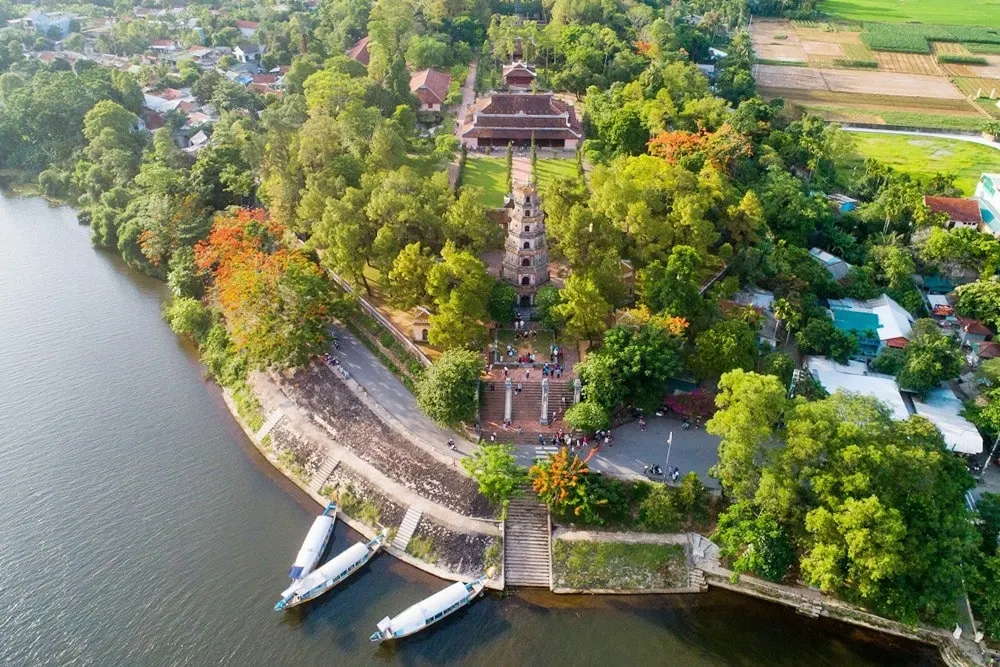
No journey through the temples and pagodas of Hue would be complete without Thien Mu Pagoda, also known as Linh Mu Pagoda.
Located on Ha Khe Hill overlooking the Perfume River, Thien Mu was founded in 1601 under Nguyen Hoang, the first Nguyen lord to govern the southern territories. According to legend, an elderly woman appeared on the hill and predicted that a lord would build a pagoda there to bring prosperity to the region. The name “Thien Mu” is commonly translated as “Heavenly Lady”.
The pagoda’s best-known structure is Phuoc Duyen Tower. Built in the 19th century, the seven-storey octagonal tower rises above the riverbank and has become an unofficial symbol of Hue. It is often the first image travellers associate with the city.
However, Thien Mu is much more than a photogenic tower. Walking through the complex, visitors encounter guardian statues, stone steles, bonsai gardens, ceremonial halls and residential areas used by the monastic community. A large bell cast in the early 18th century is another important feature of the complex.
The pagoda also preserves a historic Austin car associated with the Buddhist monk Thich Quang Duc. In 1963, he travelled in this vehicle to Saigon, where he set himself on fire in protest against the persecution of Buddhists by the South Vietnamese government. The display gives Thien Mu a powerful connection to the social and religious upheavals of modern Vietnamese history.
One of the most memorable ways to reach the pagoda is by dragon boat along the Perfume River. The journey presents the site as it was intended to be seen: above the water, framed by trees and open sky.
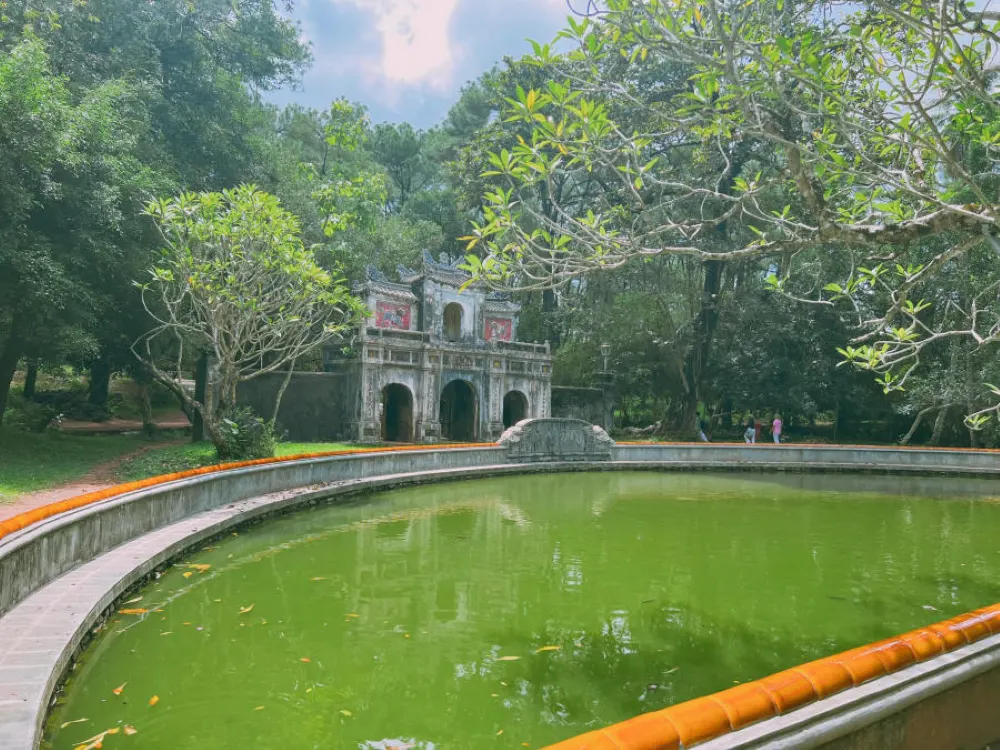
While Thien Mu is monumental and widely visited, Tu Hieu Pagoda offers a quieter and more contemplative experience.
Hidden within a pine forest south-west of central Hue, Tu Hieu originated from the An Duong Hermitage founded by Zen master Nhat Dinh in 1843. The story of its foundation is linked to filial devotion. According to local tradition, Nhat Dinh cared for his elderly mother and personally sought food to help restore her health, even when doing so attracted criticism from people who misunderstood his intentions.
The name “Tu Hieu” reflects the virtues of compassion and filial piety. Its history later became connected with the eunuchs of the Nguyen imperial court. As many of them had no descendants to maintain ancestor worship, they supported the pagoda and entrusted its monks with caring for their memorials after death. Today, visitors can see their tombs within the complex.
The pagoda is arranged around peaceful courtyards, ponds and traditional buildings with curved tiled roofs. Depending on the season, the landscape may feature lotus flowers, fallen leaves or a light mist among the pine trees. Unlike a grand royal monument, Tu Hieu reveals its beauty gradually.
The site is also associated with the late Zen master Thich Nhat Hanh, an internationally renowned teacher of mindfulness and engaged Buddhism. He entered monastic life at Tu Hieu as a young man and returned there to spend his final years. This connection has attracted Buddhist practitioners and visitors from around the world.
Tu Hieu is best experienced slowly. Allow time to walk around the ponds, listen to the forest and observe the architecture without treating the pagoda as simply another attraction to tick off a list.
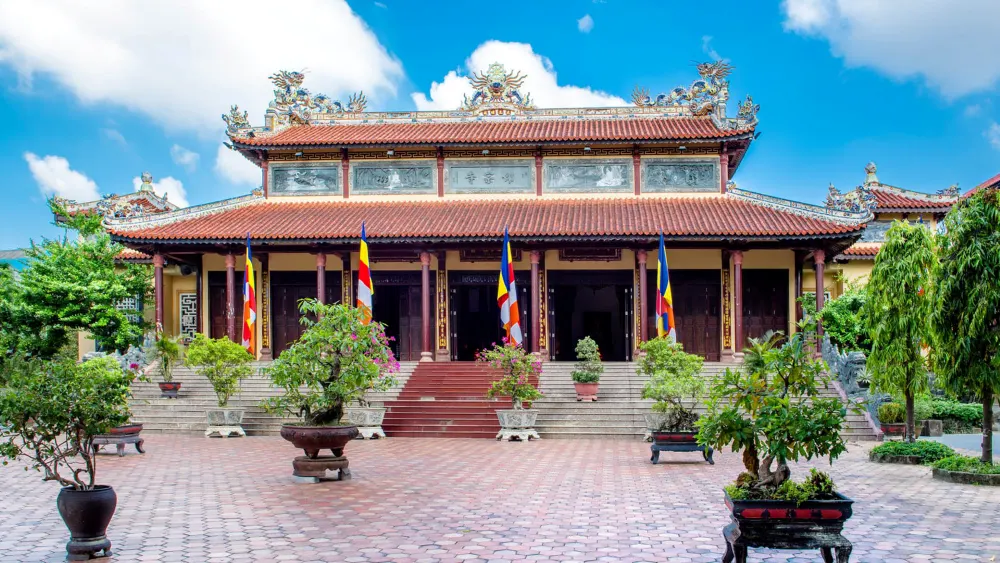
Tu Dam Pagoda is one of Hue’s most historically significant Buddhist institutions. Its origins are associated with Zen master Minh Hoang Tu Dung, who founded a place of worship in the late 17th century. Over time, the site was expanded and developed into an important pagoda.
Architecturally, Tu Dam combines traditional elements with adaptations introduced during later renovations. Visitors enter through a three-entrance gate before reaching the main ceremonial spaces. A Bodhi tree within the complex reinforces the pagoda’s connection with the Buddha’s enlightenment.
Tu Dam became particularly important during the 20th-century Buddhist revival in Central Vietnam. It served as a meeting place for Buddhist organisations, education and social activities. The pagoda was also connected to the Buddhist movement of 1963, when religious communities protested against the discriminatory policies of the Ngo Dinh Diem government.
For travellers interested in more than decorative architecture alone, Tu Dam offers valuable insight into the role Buddhist institutions have played in modern Vietnamese society.
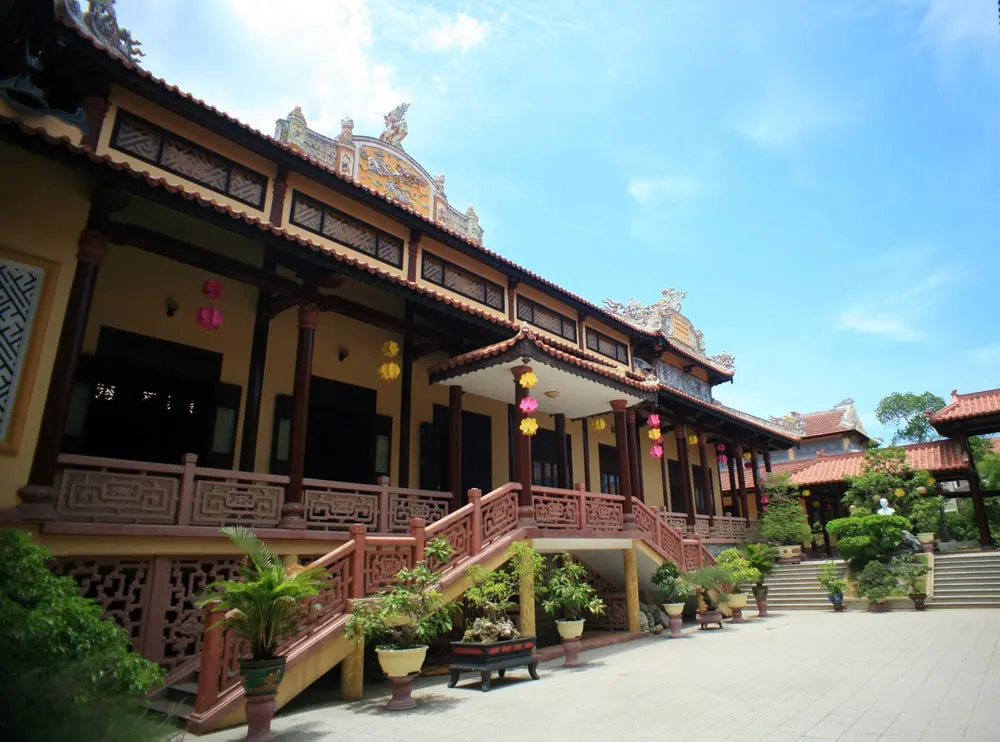
Located near the Gia Hoi area, Dieu De Pagoda once belonged to the group of national pagodas supported by the Nguyen court. It was founded during the reign of Emperor Thieu Tri in the 19th century, on land associated with the emperor’s birthplace.
The complex has changed considerably as a result of war, political upheaval and reconstruction. Nevertheless, it remains historically important. Its surviving structures include the main sanctuary, ceremonial gate, bell towers and decorative elements reflecting traditional Hue design.
Dieu De Pagoda was another important location during the Buddhist movement of 1963. Its history therefore connects the patronage of the Nguyen Dynasty with the political and religious developments of modern Vietnam.
The nearby Gia Hoi neighbourhood is also worth exploring. The area contains old streets, traditional houses and communal religious buildings that offer a glimpse of Hue beyond its better-known imperial attractions.
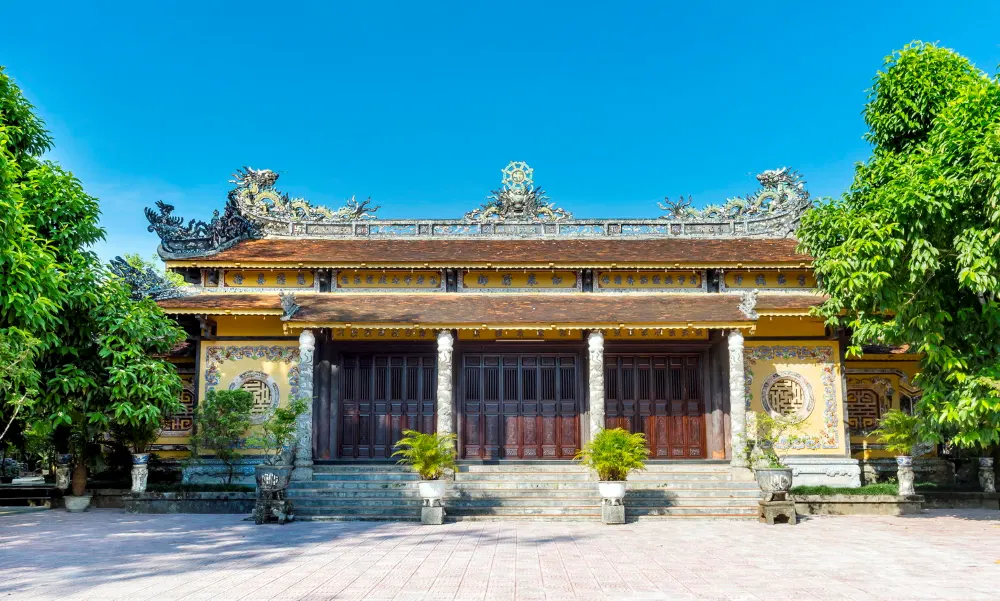
Bao Quoc Pagoda stands on Ham Long Hill, not far from Hue railway station. Although it is easily accessible, it often feels less crowded than Thien Mu.
The pagoda has roots dating back to the late 17th century and later received support from the Nguyen rulers. Its elevated position, shaded grounds and traditional gateway create a peaceful atmosphere despite its proximity to the city centre.
Bao Quoc has long been associated with Buddhist education and monastic training. For visitors, this makes it more than simply an architectural monument: it remains part of a living religious tradition.
The buildings display features typical of Hue’s sacred architecture, including restrained proportions, layered tiled roofs, wooden structures and carefully arranged courtyards. The design does not seek to dominate the surrounding landscape. Instead, architecture, vegetation and topography are treated as parts of a unified composition.
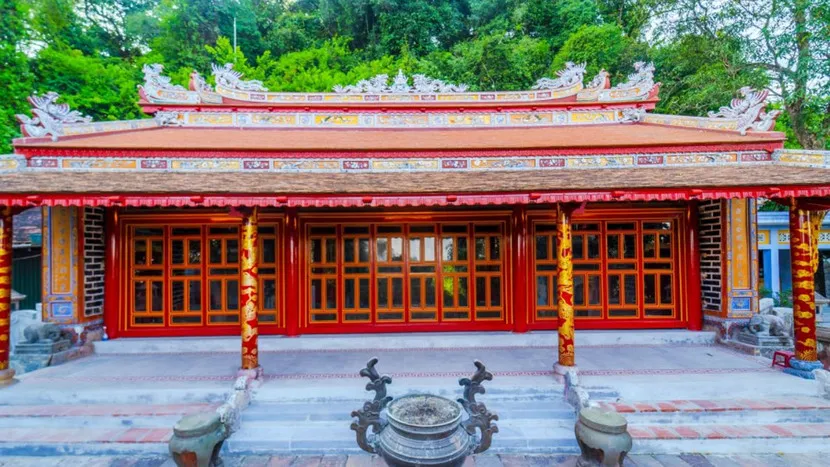
Not all of Hue’s sacred sites are Buddhist pagodas. Hon Chen Temple, also known as Hue Nam Temple, demonstrates the diversity of the city’s spiritual traditions.
Located upstream from central Hue on Ngoc Tran Mountain, the temple overlooks the Perfume River. It is closely associated with the worship of the goddess Thien Y A Na, whose origins are linked to the Cham deity Po Nagar. Over time, Cham, Vietnamese folk and royal religious elements became combined at the site.
The temple received particular attention during the reign of Emperor Dong Khanh, who was personally devoted to the goddess. Its architecture is therefore unusual, combining a spectacular natural setting with richly decorated religious interiors.
Hon Chen is also the centre of a colourful community festival held twice a year. Processions of decorated boats travel along the Perfume River, accompanied by music, costumes and ritual performances.
Travellers can reach the area by road, but approaching by boat offers a better understanding of the relationship between the temple, mountain and river. From the water, the temple appears as part of the natural landscape rather than an isolated architectural attraction.
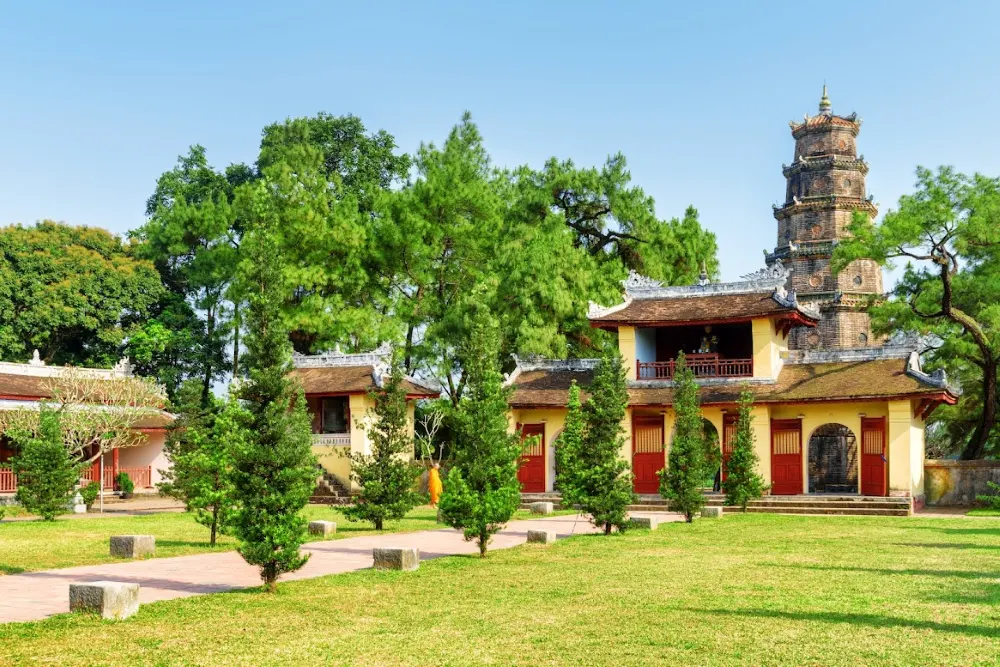
Located among hills and pine forests about 14 km from central Hue, Huyen Khong Son Thuong is a peaceful pagoda belonging to the Theravada Buddhist tradition, founded in 1989 by Venerable Gioi Duc.
Surrounded by nature, the complex is distinguished by its simple, harmonious architecture, set among woodland, ponds, water lilies, bamboo and orchids. In addition to spaces dedicated to meditation and monastic life, the pagoda is associated with poetry, calligraphy and contemplative culture.
A visit encourages you to slow down: walking along forest paths, observing the small lakes and pausing in the pavilions allows you to appreciate the monastery’s quiet atmosphere and its close relationship with the surrounding landscape.
Rather than grandeur, Huyen Khong Son Thuong captivates through its balance of spirituality, architecture and nature, offering an ideal place for those seeking tranquillity away from Hue’s busier routes.
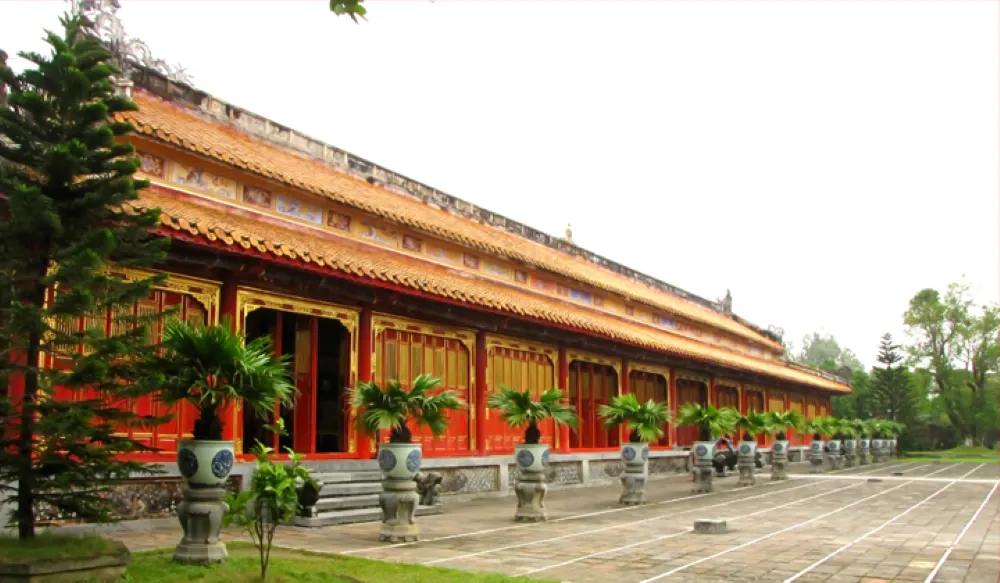
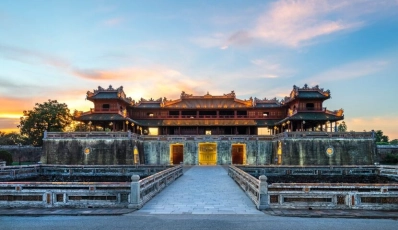
Inside the Imperial City, The Mieu represents another aspect of Hue’s sacred heritage. Rather than functioning as a Buddhist pagoda, it was built for the worship of the Nguyen emperors.
The temple stands within a formal courtyard alongside the Hien Lam Pavilion and the Nine Dynastic Urns. These monumental bronze urns symbolise the authority and unity of the dynasty. Each incorporates decorative images representing landscapes, plants, animals and other characteristic elements of Vietnam.
The Mieu helps visitors understand the importance of ancestor worship at the Nguyen court. Political legitimacy was connected not only to administration and military power, but also to ritual responsibility. The emperor operated within a system that linked family lineage, morality and cosmic order.
When exploring the Imperial City, this area should not simply be viewed as a collection of old buildings. Its spatial organisation reflects a carefully structured ritual world in which architecture, ceremony and political authority were closely connected.
Hue can be visited throughout the year, although each season creates a different experience at its temples and pagodas.
From February to April, temperatures are generally pleasant, gardens are fresh after the rainy season, and the weather is suitable for walking or cycling between religious sites. It is one of the most comfortable periods for exploring Hue.
The summer months, particularly from May to August, can be hot and humid. If you are travelling during this period, visit the pagodas in the early morning or late afternoon. Morning visits also offer a quieter environment and softer light for photography.
During the rainy season, Hue becomes cooler and more atmospheric, although heavy rain can affect boat trips and outdoor activities. Mist, darkened roof tiles and wet gardens can give the city’s sacred buildings a particularly contemplative appearance.
Religious festivals and major Buddhist celebrations offer an opportunity to experience lanterns, chanting, processions and traditional ceremonies. However, these occasions can also attract large numbers of worshippers. Visitors looking for a peaceful experience should choose a regular weekday and arrive early.
As Hue’s temples and pagodas remain active places of worship as many others in Vietnam, respectful behaviour is essential.
Most importantly, remember that these sites are not historical sets created for tourism. They are living religious communities where people study, meditate, pray and remember their ancestors.
An experience among the temples and pagodas of Hue reveals a quieter side of Vietnam’s former imperial capital. From Thien Mu and Tu Hieu to Hon Chen Temple and The Mieu, these sacred places preserve centuries of Buddhism, royal rituals, local beliefs and architectural traditions.
More than historical monuments, they remain living cultural spaces where Hue’s relationship with spirituality, nature and memory continues to find expression.
Planning a trip to Vietnam and want to discover its culture, traditions and local life? IZITOUR helps you create a tailor-made itinerary with authentic experiences and transfers suited to your journey. Contact us at +84 382 536 266 or by email at [email protected] to start planning your trip to Vietnam.
Read more:





 TRAVELERS' CHOICE 2026