

Le 11 et le 12 novembre soit de nuit merci de me faire des propositions
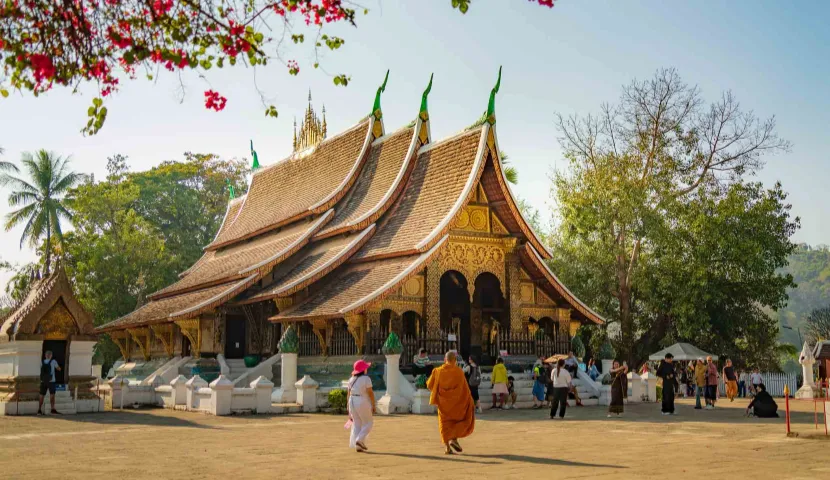
Nestled in the heart of Laos, a country where spirituality permeates every aspect of daily life, Wat Xieng Thong is one of the most iconic temples in Luang Prabang. A true masterpiece of traditional Lao architecture, this centuries-old sanctuary captivates visitors with its elegant, sweeping roofs that nearly touch the ground and its sparkling mosaics. To visit Wat Xieng Thong is to delve into the spiritual soul of Laos and discover a place rich in history, serenity, and timeless beauty.
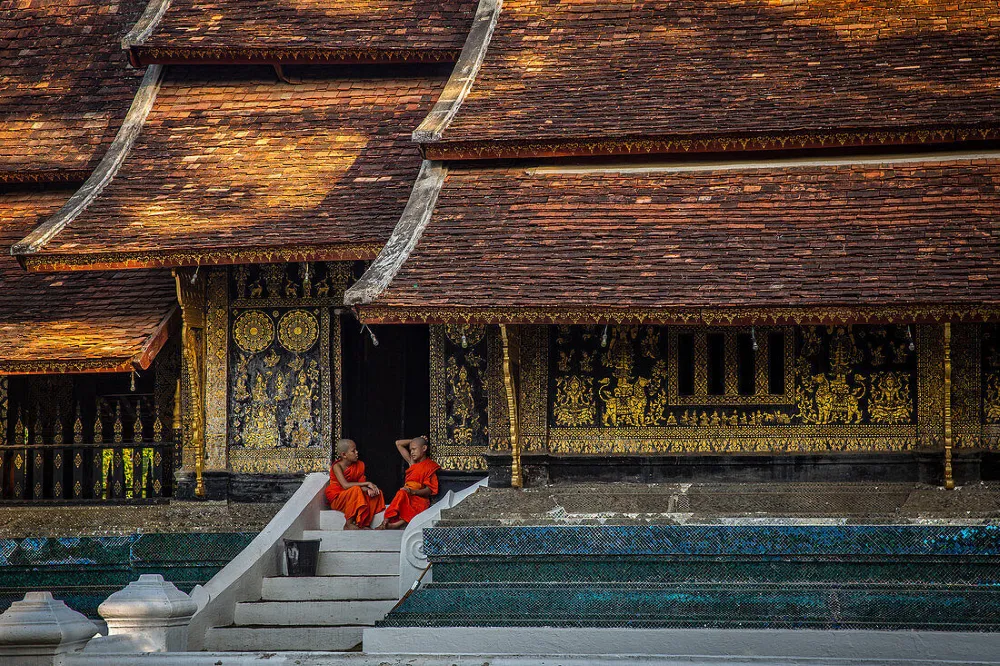
In Lao, Wat Xieng Thong means "Temple of the Golden City". The sanctuary occupies a vast, privileged location where the Nam Khan River meets the majestic Mekong River. Considered one of the oldest temples in the former royal capital, Wat Xieng Thong is not only the most beautiful and important religious structure in Luang Prabang; it also preserves remarkable traditional architecture and precious ancient murals. A true symbol of Lao Buddhist heritage, it perfectly embodies the aesthetics and culture of the country's historical temples.
Despite its age and great popularity among travellers, Wat Xieng Thong has managed to maintain a sacred atmosphere and profound serenity. The temple's peaceful setting seems enveloped in a timeless softness, offering every visitor a feeling of calm, harmony, and tranquillity from the very first steps.
Wat Xieng Thong was constructed between 1559 and 1560 under the reign of King Setthathirat, during the golden age of the Kingdom of Lan Xang, also known as the "Land of a Million Elephants." At that time, Buddhism played a central role in the spiritual life of the inhabitants, and the temple quickly became a major symbol of the local population's Theravada Buddhist faith.
In the 1970s, Wat Xieng Thong served as the venue for several Lao royal coronation ceremonies. Today, it remains an unmissable religious site where many annual festivals and celebrations in Luang Prabang are held, thus perpetuating its historical and cultural importance.
Wat Xieng Thong is the largest religious complex in Luang Prabang, built in the traditional Lao architectural style dating back to the 16th century. The complex includes more than twenty buildings of various sizes, all harmonised around the Sim – the main ordination hall – creating a deeply cohesive and sacred spiritual complex.

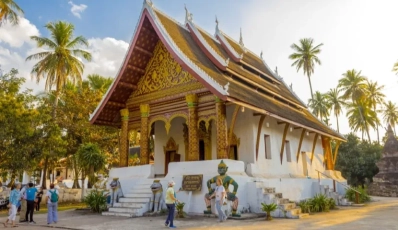
The most impressive part of Wat Xieng Thong is undoubtedly the Sim, the main ordination hall. Built in the ancient traditional style, the structure is distinguished by its long, wide, cascading roof that nearly descends to the ground. Both the interior and exterior are richly adorned with fine gold motifs, elegantly contrasting against a black lacquer background. The walls are decorated with delicate gold applications depicting animals, flowers, and scenes of everyday Laos life.
At the centre of the sanctuary is a majestic altar housing a large gilded statue of Shakyamuni Buddha, surrounded by several smaller statues. On either side, large columns richly decorated with gold motifs enhance the solemn and sacred atmosphere of the place.
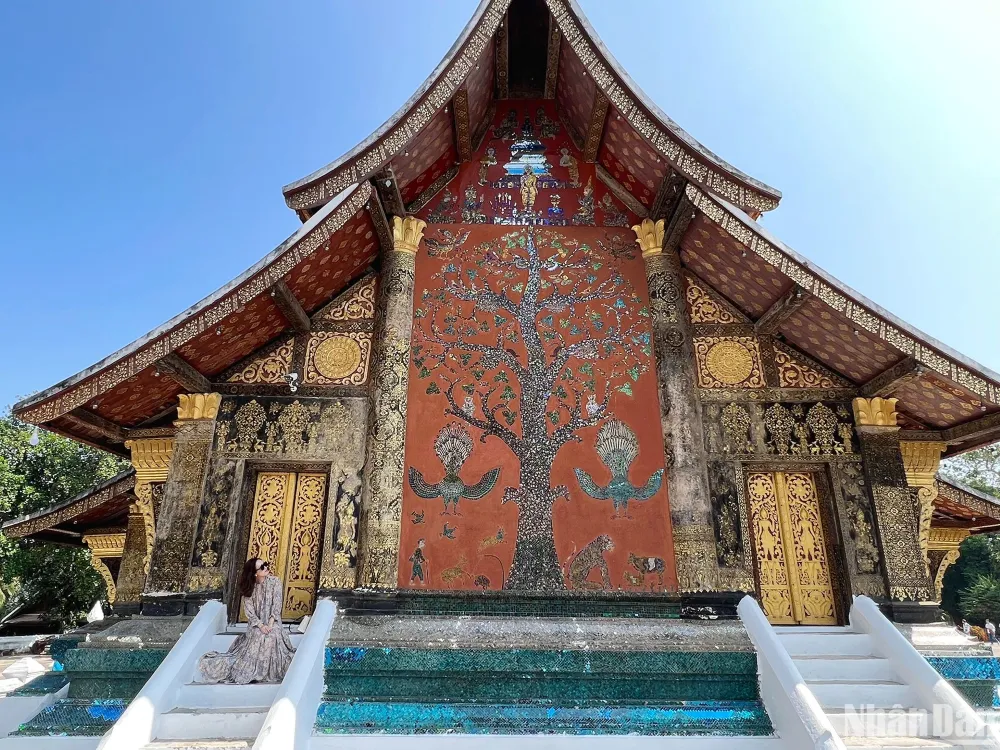
On the exterior rear wall of the building is the famous coloured glass mosaic depicting the “Tree of Life” on an orange-red background. Considered one of the temple's most admired masterpieces, this emblematic decoration perfectly illustrates the artistic and spiritual beauty of Wat Xieng Thong.
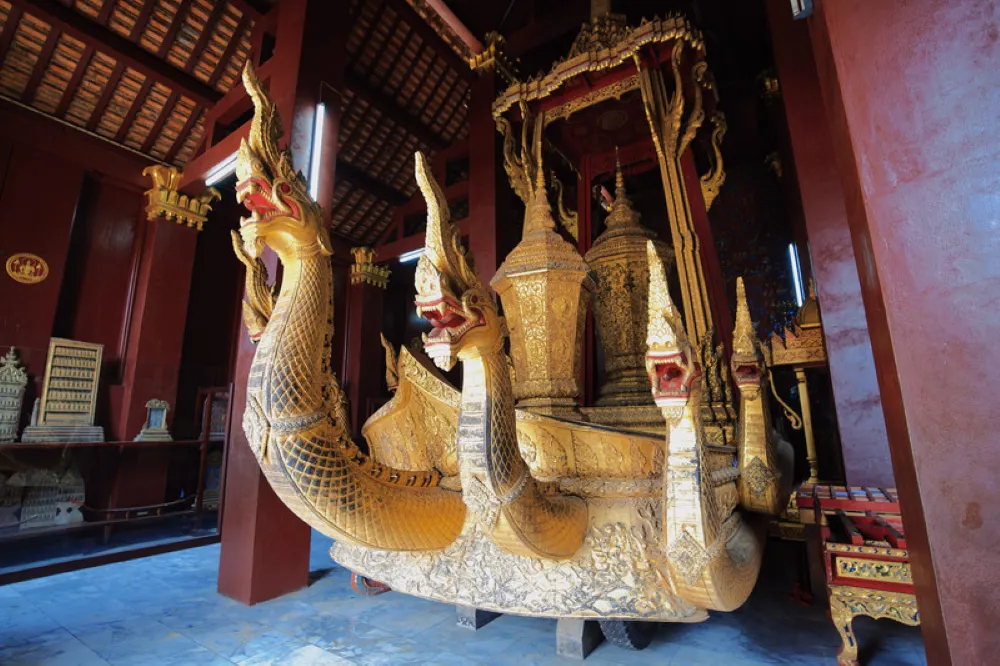
Near the entrance, on the left, is a small shrine housing the funeral chariot of King Sisavang Vong – the last King of Laos, who died in 1959. Entirely carved from wood and covered with gold leaf, this chariot impresses with its majestic brilliance. Its base is adorned with motifs representing the Naga, the mythical protective serpent of Buddhism. Inside, three intricately crafted urns contain the ashes of King Sisavang Vong and his parents, adding an exceptional historical and spiritual dimension to this unique place.

One of the most remarkable treasures of Wat Xieng Thong is the reclining Buddha statue, also known as the Nirvana Buddha. Considered one of the most impressive representations in Laos, this statue was once exhibited in a Paris museum before being repatriated to Luang Prabang in 1964. It is covered in gold leaf and decorated with fine details. It depicts the Buddha entering Nirvana, lying on his right side, with his right hand resting along his thigh and his left extended parallel to his body. His peaceful and serene face evokes spiritual awakening and liberation.
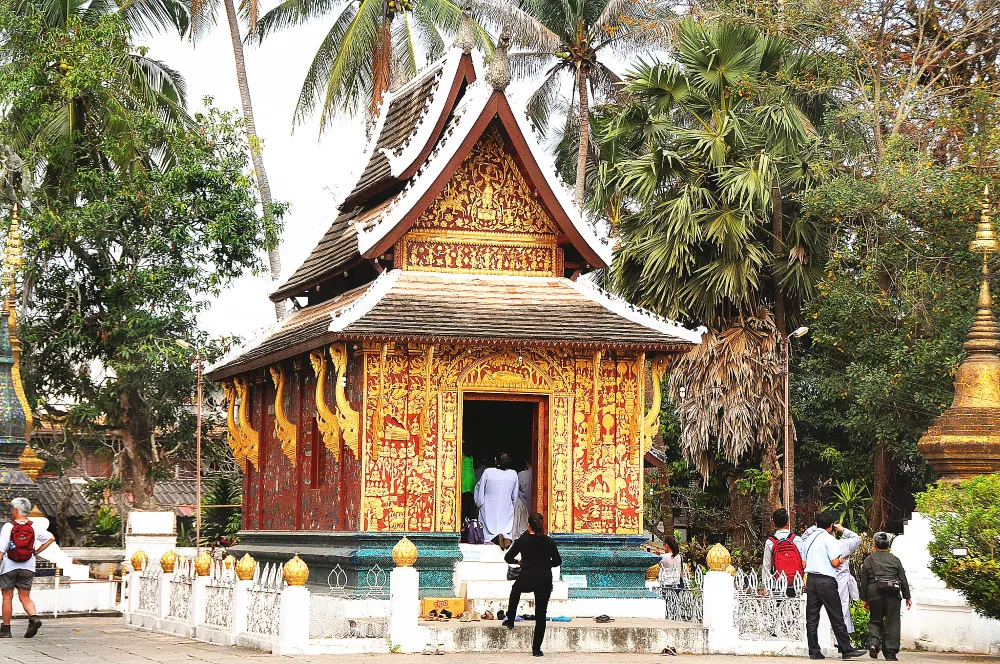
Next to the main ordination hall, several small chapels with deep religious significance enrich the entire complex. Each features a particular decorative style and houses unique sacred elements. The Red Chapel stands out for its vibrant colours and houses a precious reclining Buddha statue. Not far from there, the Standing Buddha Chapel displays a slender, elegantly poised statue with strong symbolism. Together, these chapels constitute places of reflection and contemplation, inviting every visitor to immerse themselves in the spirituality of Wat Xieng Thong.
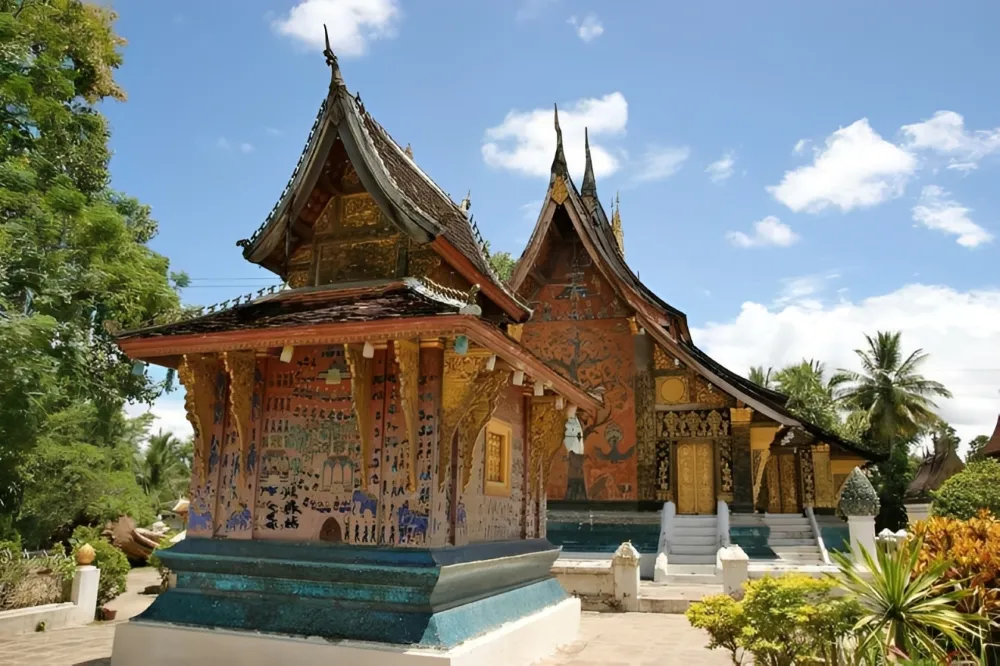
Just behind the Sim is the temple's library, a particularly original and distinctive architectural space. Designed to preserve the sacred texts of Buddhism, the library is elevated on wooden pillars to protect the manuscripts from humidity and termites. Thanks to this ingenious structure, the ancient scriptures are preserved in optimal conditions. This is also where the volumes of the Tripitaka are kept – the collection of Buddhist canonical texts comprising three sections: the Sūtra, the Vinaya, and the Abhidharma.
Nearby stands a tall drum tower, finely carved with delicate motifs, which helps to reinforce the sacred atmosphere of the complex. There is also a funeral building designed with great solemnity, offering a final, spiritually dedicated space for rites for the deceased.
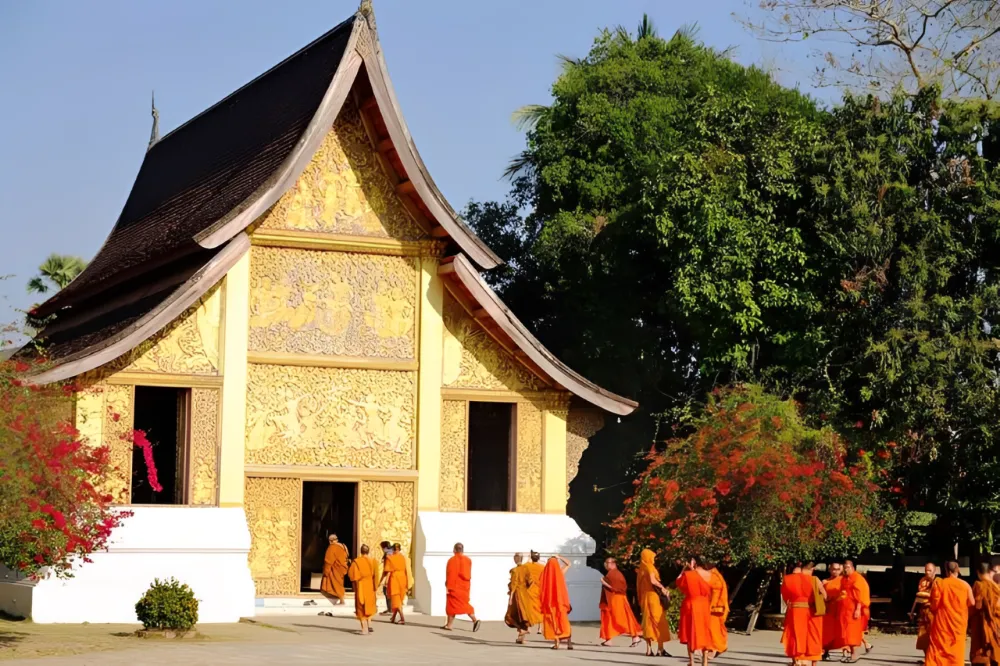
Wat Xieng Thong is not merely an ancient sacred temple where devotees and locals come to express their devotion to the Buddha; it is also a place for the preservation of the culture and arts of the Kingdom of Lan Xang. The temple annually attracts many visitors, both local and international, eager to closely admire the ancient frescoes that cover its walls and learn more about the Lao artistic heritage.
Today, Wat Xieng Thong occupies an essential place in the cultural and spiritual life of Luang Prabang. A true haven of peace in the heart of a vibrant city, it remains a space for meditation, contemplation, and the transmission of Buddhist values, offering travellers a profoundly soothing and spiritual experience.
Wat Xieng Thong is located at the northern tip of the Luang Prabang peninsula, at the junction of the Mekong and Nam Khan rivers, between Khem Khong and Sakkaline roads. From the city centre, you can easily walk there. If your accommodation is further away, it is also possible to hire a bicycle, a scooter, or take a tuk-tuk to reach the temple in a few minutes.
After many centuries of existence, Wat Xieng Thong has preserved all its simple yet majestic beauty, along with its ancient character. Thanks to its unique, almost intact architecture, its spiritual depth, and its traditional artistic heritage, the temple remains one of the must-see sites in Luang Prabang, a UNESCO World Heritage site. A visit to Wat Xieng Thong offers every traveller a precious immersion into the religious and cultural soul of Laos, making this place an essential stop on any discovery of the city.
See more:




 TRAVELERS' CHOICE 2026