

Earlier I thought differently, many thanks for the information.
__________
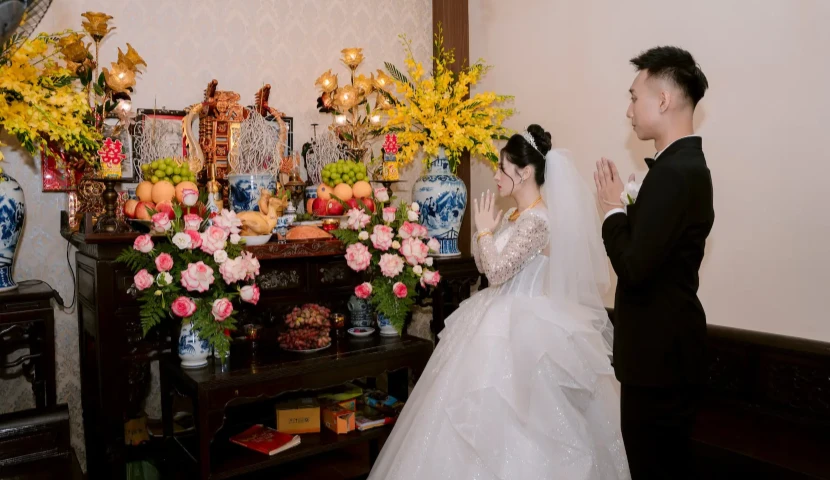
For many Vietnamese families, ancestor worship is far more than a set of rituals involving incense, flowers, photographs and offerings, it embodies family memory, gratitude and the continuity between generations. This centuries-old Vietnamese tradition stems from ancient concepts of family and the value of filial piety. Over the centuries it has been deeply shaped by Confucianism, while also intertwining with Buddhism, Taoism and Vietnamese folk beliefs. Although practices vary by region, religion and family, they all share the same purpose: to honour those who came before and to preserve a meaningful connection between past and present generations.
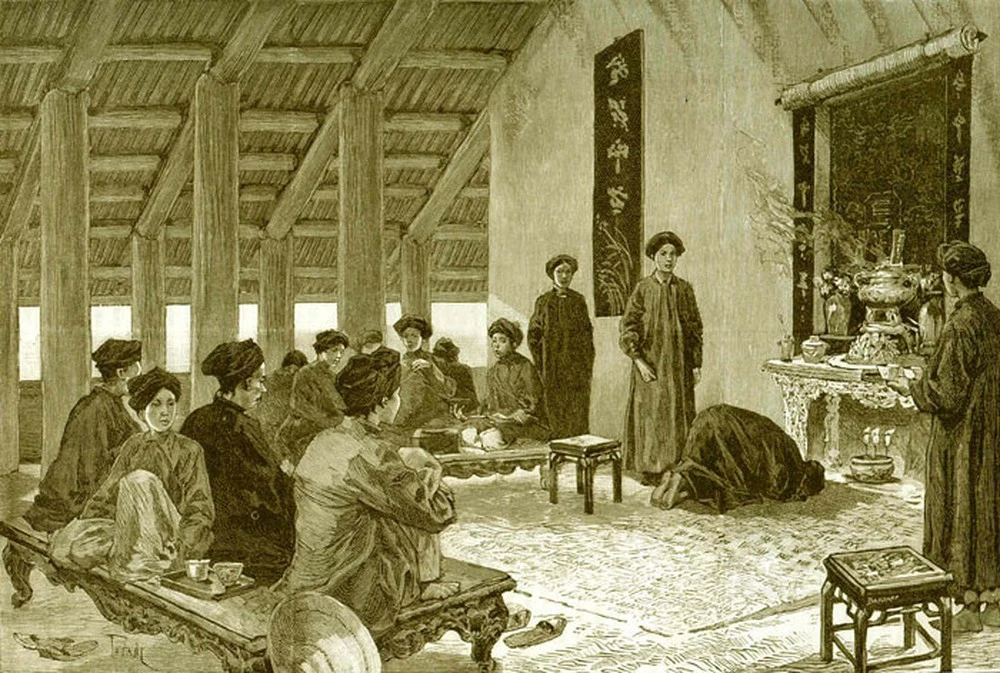
At the heart of ancestor worship in Vietnam lies the belief that family bonds do not simply end with death. Parents, grandparents and earlier ancestors continue to hold an important place in family memory. Honouring them is a way of expressing gratitude for the life, care, land, reputation, values and opportunities they passed on to their descendants.
This idea is closely tied to the Vietnamese moral concept of hiếu, or filial piety. In contemporary Vietnamese culture, it represents a core value encompassing respect for parents, gratitude for one's origins, and the preservation of inherited family values. Over time, Confucianism reinforced and formalised these obligations, while Buddhism, Taoism and folk beliefs helped shape the Vietnamese understanding of death, the soul and memory.
For this reason, ancestor worship should not be reduced to simply "praying to the dead." For many families, this practice serves moral and social functions just as much as spiritual ones. The family altar reminds younger generations where they come from. Death anniversaries bring relatives together. Key moments in family life are symbolically linked to those who came before. In this sense, the tradition forms a bridge between personal memory and collective family identity.
A well-known Vietnamese proverb captures this principle perfectly: uống nước nhớ nguồn, literally "when you drink the water, remember its source." The saying recalls the duty to remember those whose sacrifices and efforts made the present possible.
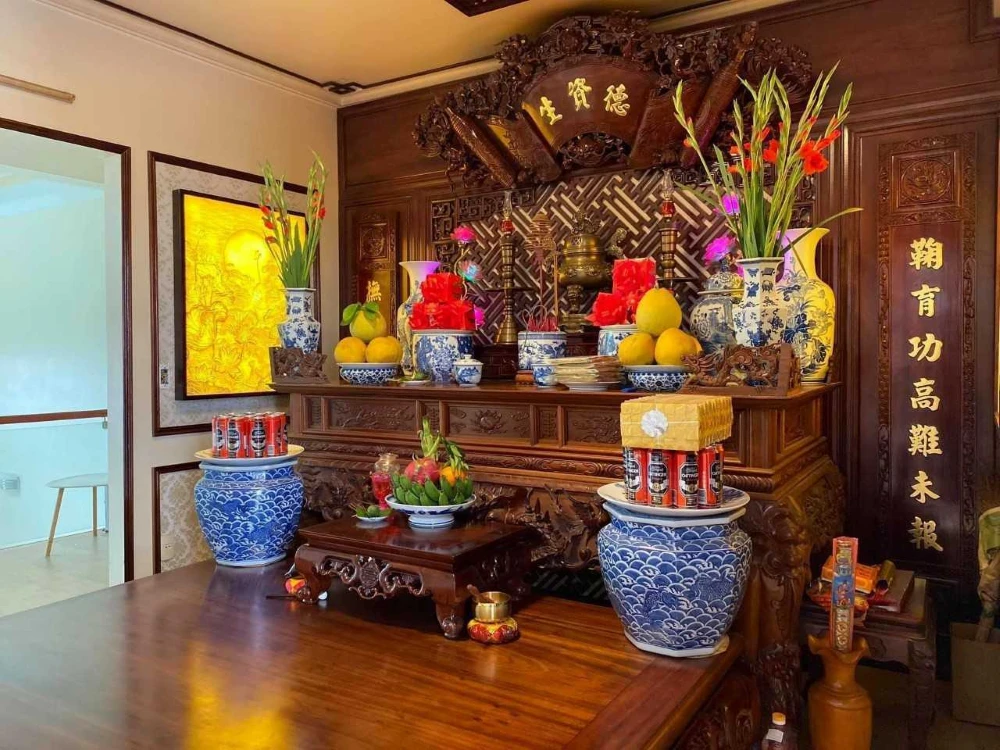
As part of ancestor worship in Vietnam, most families keep an ancestor altar, known in Vietnamese as bàn thờ gia tiên, usually placed in a respected and important area of the home. Its form can vary considerably. In a traditional house, it may be a large wooden altar in the main room, while in a modern apartment it might be a compact structure mounted on the wall.
The arrangement depends on many factors, including the family's financial circumstances, the architecture of the home, regional background, religion and family preferences.
Burning incense is one of the central elements of the ritual. Families may also place photographs or memorial tablets of deceased relatives on the altar, along with candles or lamps, vases of flowers, cups of water or tea, fruit and other offerings. On especially important occasions, cooked dishes may also be prepared as symbolic offerings.
The meaning behind these offerings matters far more than the altar's size or monetary value. In Vietnamese culture, it is often emphasised that elaborate or costly offerings are not essential to show sincere devotion. Even the simple act of lighting a stick of incense on the anniversary of a relative's death, during Tết, or on another important occasion can be a genuine gesture of respect.
The altar is also seen as a kind of symbolic centre of the family. Important events such as a wedding, a long journey, the start of the new year, or a significant life change may be accompanied by a moment of prayer or an offering to the ancestors.
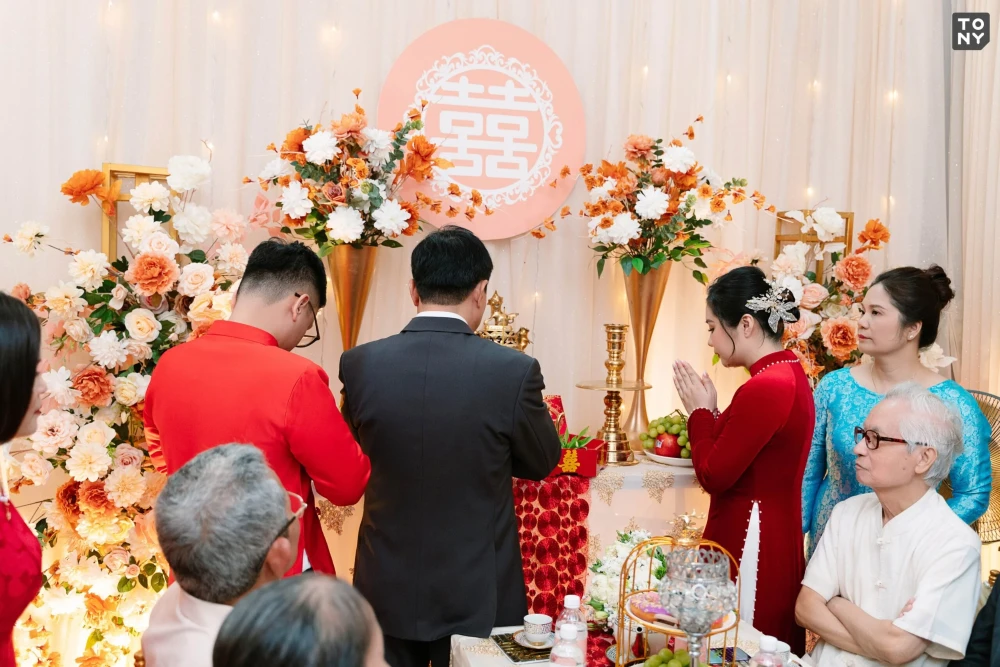
At Vietnamese weddings, for instance, it is common for the bride and groom to take part in a ceremony in front of the family altar. In this way, the new union is symbolically presented to the ancestors and woven into the continuity of the family's history.
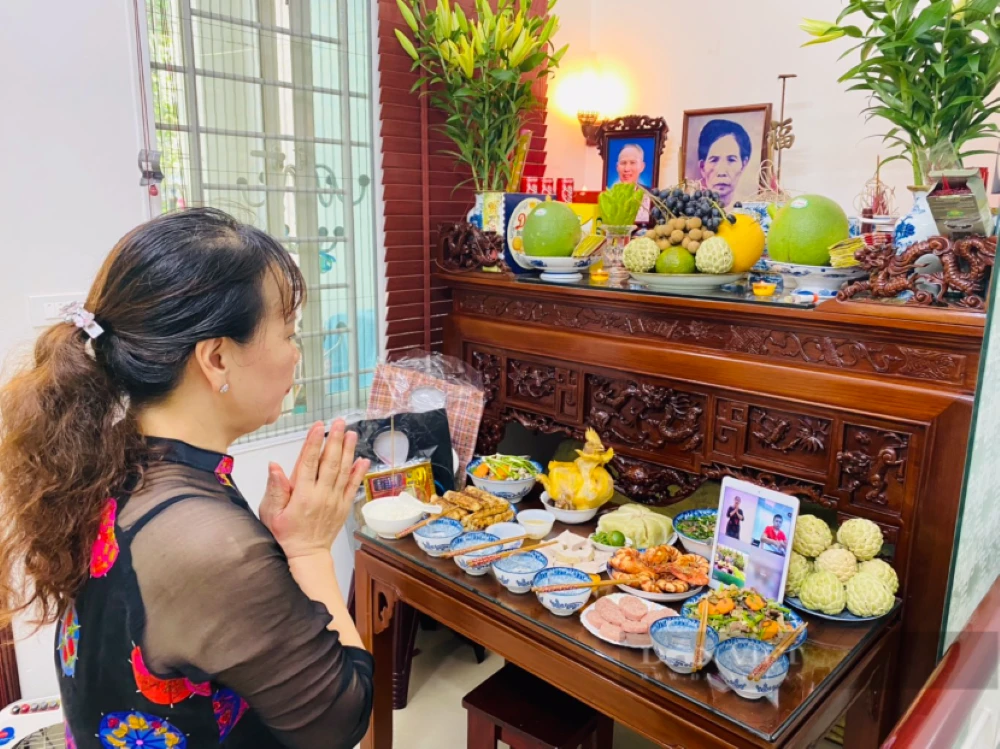
There is no single ritual followed by all Vietnamese families. Some hold elaborate ceremonies with formal prayers and carefully prepared offerings, while others prefer to keep the practice very simple.
The most common elements include cleaning the altar, preparing offerings, lighting incense, bowing or praying, and gathering family members to remember the deceased.
The food offered to ancestors often reflects what the family itself would prepare for an important meal. Depending on the occasion, this may include fruit, tea, rice, traditional dishes, sweets, wine, flowers and incense.
This does not necessarily mean descendants believe the ancestors literally consume the food. The offering is above all a symbolic gesture of hospitality, remembrance and sharing.
After the ritual, the food is usually eaten by family members. The offering thus becomes part of a shared meal rather than something entirely separate from everyday life.
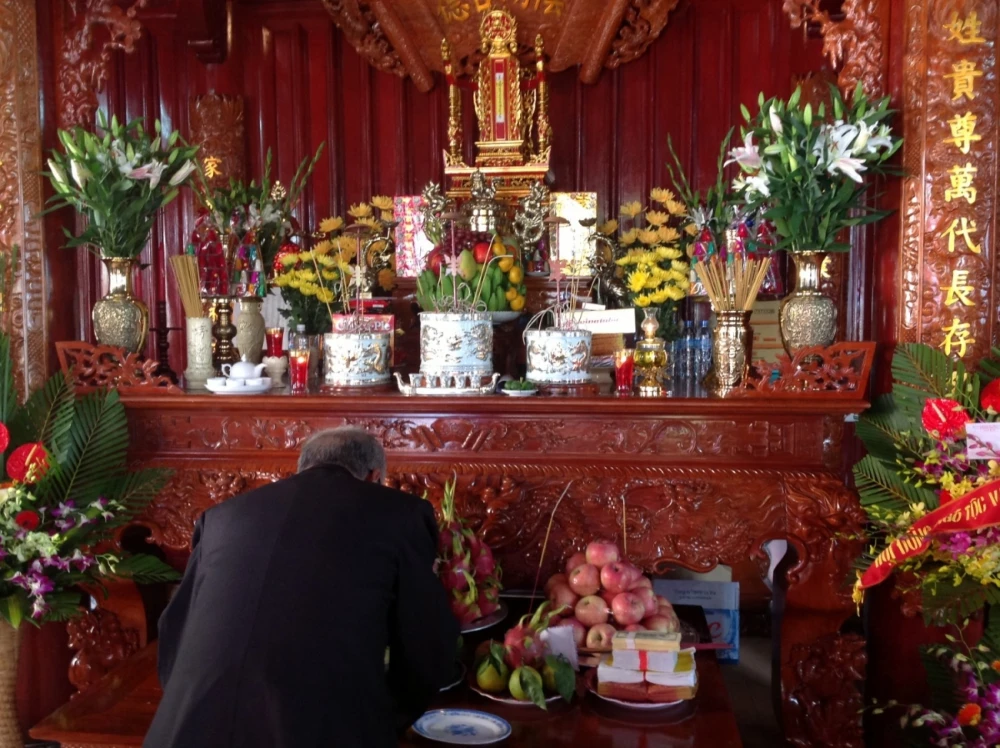
One of the most important family occasions linked to ancestor worship is the giỗ, the annual anniversary of a relative's death.
Unlike a birthday, which celebrates the start of a person's life, giỗ marks the day of their death according to the calendar the family uses, often the lunar calendar.
On this occasion, relatives may return to the family home, prepare food, light incense and share a meal together. For more recent ancestors, this commemoration may be held every year.
Some traditions from southern Vietnam also show how ancestor anniversaries can help preserve the identity of an entire clan.
One example is cúng việc lề, a practice found in some southern families, through which the earliest ancestors and the history of family migrations are remembered. These ceremonies are not only a gesture of gratitude towards the deceased but also help strengthen a sense of belonging to the family line and collective memory.
This example illustrates an important point: practices related to ancestor worship are not identical throughout Vietnam. Regional history and traditions play a decisive role.
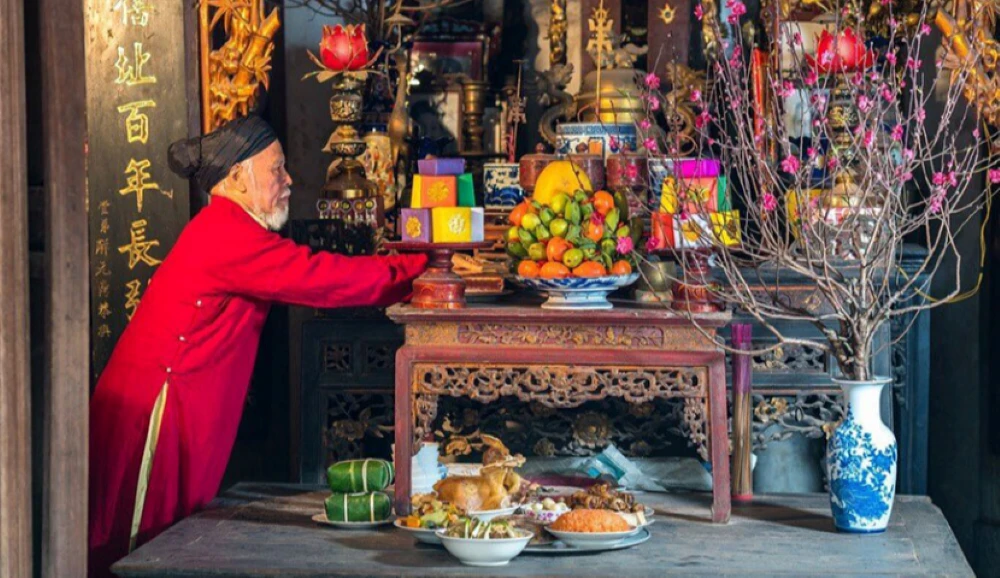
Tết Nguyên Đán, the Vietnamese Lunar New Year, is probably one of the times of year when ancestor worship in Vietnam becomes most visible.
In the run-up to the festival, families clean and decorate the altar, prepare traditional dishes, arrange fruit and flowers, and light incense as part of the New Year celebrations.
In Vietnamese culture, Tết represents a time of reunion that symbolically involves not only living family members but also deceased ancestors.
People returning to their hometown may visit family graves, pray before the household altar, and prepare offerings before the New Year arrives.
Common offerings may include bánh chưng, bánh tét, fruit, flowers, tea, wine, sweets and cooked dishes. Traditions, however, differ between northern, central and southern Vietnam.
Even the well-known five-fruit tray can be arranged differently depending on the region. What remains constant is the intention: the family welcomes the new year while also remembering its roots.
Tết therefore reveals something essential about the Vietnamese understanding of family. A family reunion is seen not only horizontally, as a gathering of siblings and cousins, but also vertically, as a connection between past, present and future generations.
Tết, however, is not the only time of year when this bond with ancestors is expressed. Other occasions, such as the Hùng Kings' Commemoration Day (Giỗ Tổ Hùng Vương), a national holiday honouring the legendary founders of Vietnam, or Tết Thanh Minh, a period traditionally dedicated to visiting and tending family graves, show how present ancestor worship remains in Vietnamese cultural life beyond the Lunar New Year.
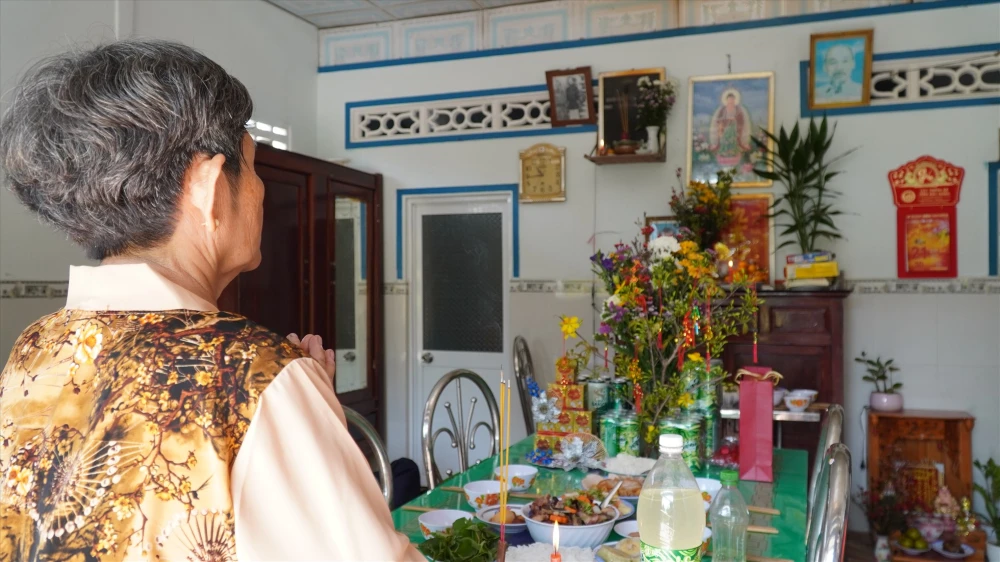
It can be easy to speak of Vietnamese traditions as though they were uniform, but practices related to ancestor worship vary considerably from one region to another.
Historically, northern Vietnam developed strong lineage structures, family genealogies and ancestral houses connected to extended clans.
In parts of central Vietnam too, clan organisation and more elaborate family rituals have retained an important role.
Southern Vietnam, by contrast, developed under different historical conditions, particularly through migration and the expansion into new lands mainly between the 17th and 18th centuries.
Some southern families adapted the old Confucian-influenced lineage traditions, turning them into simpler family or clan ceremonies. In areas such as Long An, for example, certain practices were shaped by the history of migration and local social conditions rather than simply replicating northern models.
The same principle can be seen in contemporary urban life.
A family living in a modern flat in Ho Chi Minh City or Hanoi may have far less space than a multigenerational family living in a traditional countryside home. The altar may therefore become smaller and simpler, while its meaning remains essentially unchanged.
In other words, a tradition is not necessarily preserved by rejecting all change. It can continue to live precisely because of its ability to adapt.
Visitors entering a Vietnamese home are generally not expected to take part in rituals dedicated to ancestors unless explicitly invited. In most cases, it is enough to behave respectfully.
It is advisable not to touch or move objects on the altar without the family's permission, and not to place personal belongings on it.
During a ceremony, it is best to observe how family members behave and follow their lead.
If invited to light a stick of incense, it is best to watch how others do it and treat the moment with respect, rather than seeing it simply as a photo opportunity.
It is also important not to make assumptions.
One family may be happy to explain the meaning of every item on the altar, while another may consider it a private and intimate space.
Traditions around incense, bowing, offerings and religious meaning can vary considerably.
For visitors to Vietnam, the best approach is therefore to be curious without being intrusive. Ancestor worship is not simply an exotic custom — it can represent the memory of many generations of a single family.
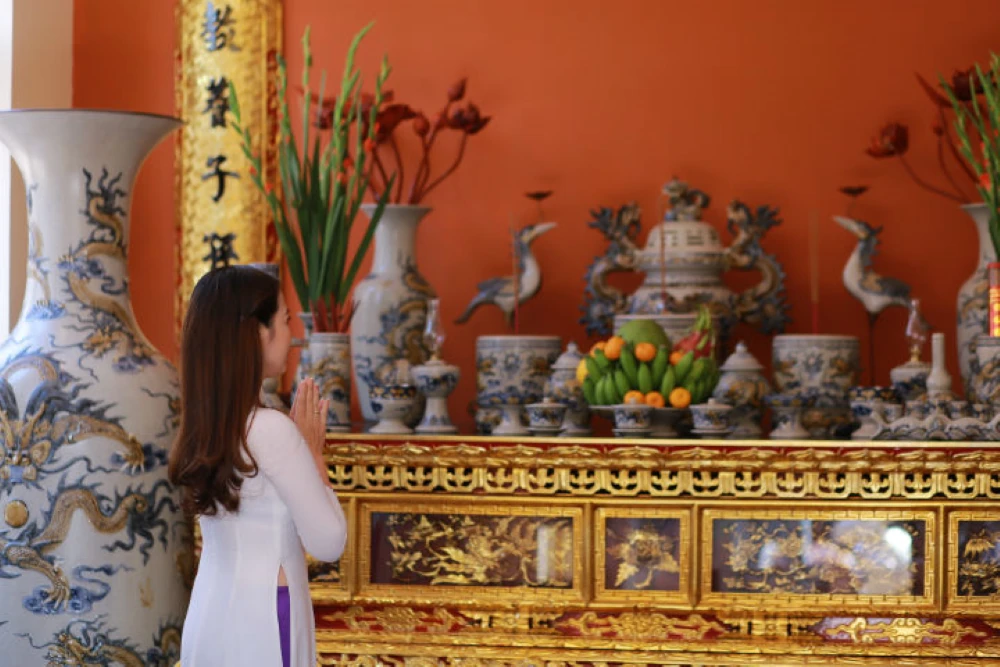
Vietnam today is undergoing significant change, especially in major cities, where urban and technological development is increasingly visible, while rural areas continue to hold on to deeply rooted rhythms of life, traditions and community bonds.
Families may live far apart from one another, move abroad, or spend much of the year in different cities.
And yet, ancestor worship in Vietnam continues to offer a point of return to one's roots, both literally and symbolically.
A death anniversary can bring relatives together in the family home. Tết encourages people to return to their hometowns and visit the graves of loved ones.
A wedding ceremony in front of the altar places a new union within a wider family story.
Even a small altar in a modern flat can keep alive the sense of continuity between generations.
The persistence of this tradition does not mean it has remained unchanged.
Roles within families are shifting, some rituals are being simplified, and younger generations may interpret these practices in a more cultural than spiritual way.
Even so, this adaptation does not necessarily weaken the core values underpinning ancestor worship.
Its meaning continues to answer a universal question in a deeply Vietnamese way: how should the living remember those who made their existence possible?
The answer is expressed through incense, food, rituals, family gatherings, stories and a sense of responsibility towards one's own family.
Ancestor worship in Vietnam is far more than a set of traditional rituals, it is a way of keeping the bond between past and present alive, passing on family values, and remembering one's origins. From the household altar to giỗ commemorations and Tết celebrations, this tradition continues to accompany the daily life of many Vietnamese families, adapting to social change without losing its deeper meaning.
Planning a trip to Vietnam and want to discover not only the country's main destinations but also its traditions, culture and local life? If you need help creating a tailor-made itinerary, arranging transfers, choosing the most authentic experiences, or finding the right balance between different stops on your journey, don't hesitate to contact us on +84 382 536 266 or by email at [email protected]. The IZITOUR team is on hand to design your personalised trip to Vietnam, blending culture, landscapes, cuisine and local experiences with transport solutions suited to every part of your itinerary.
Read more:




 TRAVELERS' CHOICE 2026